
AI Overview Ecommerce & ChatGPT Shopping
We Generated $3,225.47 In Revenue From ChatGPT Shopping Traffic.
AI shopping is no longer theory. ChatGPT, AI Overviews, Shopify Agentic Commerce and AI product discovery are already creating new ecommerce traffic and sales opportunities. This blog breaks down what happened, why it matters and how ecommerce brands can prepare.
AI Commerce Summary:
This article documents real ecommerce revenue generated through ChatGPT shopping discovery. Topics covered include AI Shopping, AI Overview Ecommerce, Shopify Agentic Commerce, AI Product Discovery, AI SEO, Generative Engine Optimisation, Product Schema, Merchant Feeds, Ecommerce SEO and Conversational Commerce.
Table of Contents
- The First Signs Of AI Commerce
- Real ChatGPT Shopping Revenue Results
- Why AI Shopping Changes Ecommerce
- What Is Shopify Agentic Commerce?
- AI Overview Product Discovery
- AI SEO vs Traditional SEO
- GEO For Ecommerce Stores
- How Products Appear Inside ChatGPT
- How To Sell More Products Through AI Discovery
- Why Most Ecommerce Stores Are Not Ready
- What AIIMS Group Is Doing Next
- Related AIIMS Pages
- FAQs
The First Signs Of AI Commerce
AI commerce is here earlier than most ecommerce brands expected.
For the last twenty years, ecommerce growth has been built around familiar channels: Google Search, Google Shopping, Meta ads, email marketing, remarketing, marketplaces, influencer content and conversion rate optimisation. Those channels still matter. They are not dead. But they are no longer the whole picture.
A new discovery layer has started to emerge: AI-powered shopping. Customers are beginning to ask AI systems what they should buy, which products suit their needs, what brands they can trust and which ecommerce stores offer the best option for their situation.
This shift changes ecommerce because customers are no longer only searching with keywords. They are asking questions, explaining problems and expecting an answer. That is where AI product discovery starts to matter.
An ecommerce store that is built only for traditional browsing may not be ready for AI shopping. A store that has structured product data, clear product descriptions, strong collection pages, reviews, FAQs, policies, schema and authority content has a much stronger chance of being understood by AI systems.
This blog is not theory. It is based on early proof that ChatGPT shopping traffic can generate ecommerce revenue. The numbers are still early, but they are important because they show what is coming next.
Proof From The First Launch Period
Real ChatGPT shopping revenue results.
During the first launch period, ChatGPT-driven shopping traffic generated measurable ecommerce activity. This matters because most brands are still talking about AI shopping as if it is a future idea. The data shows that the opportunity has already started.
$3,225.47Revenue generated from ChatGPT shopping traffic
226Visits from AI-powered shopping discovery
702%Growth signal from early launch activity
This is not enough to say that AI shopping replaces Google, Meta, email or traditional ecommerce SEO. That would be a lazy conclusion. The smarter conclusion is that ecommerce brands now have another discovery channel to prepare for.
The opportunity is not just traffic. The opportunity is high-intent traffic. When a customer asks an AI system for a product recommendation, they are often further along in the decision process than someone casually scrolling social media. They may already know the problem they want solved. They may already have a budget. They may already be asking for comparisons.
That is why ecommerce brands need to start preparing now. If your product information is weak, your schema is missing, your collection pages are thin and your reviews are not properly structured, AI systems have less to work with.
Why This Matters
AI shopping changes the way products are discovered.
Traditional ecommerce search behaviour is usually keyword-based. A customer searches for a product, a category or a brand. AI shopping behaviour is different. It is problem-based, comparison-based and recommendation-based.
A customer might ask:
- What is the best dash cam for a family car?
- What is the best solar security camera with no subscription?
- What is a good luxury gift under $500?
- Which product is better for a tradie?
- What is the best product for outdoor use in Australian weather?
These are not simple product searches. They are outcome searches. AI systems are built to interpret the outcome and recommend options.
That means ecommerce stores need to explain products in a way that answers real buyer questions. A thin product description will not be enough. A product page needs to explain use cases, benefits, comparisons, compatibility, support, delivery, reviews and policies.
Shopify Agentic Commerce
What is Shopify Agentic Commerce?
Shopify Agentic Commerce is the next phase of ecommerce where Shopify catalogues, product data, policies, knowledge bases and store content become more accessible to AI-powered shopping journeys.
The screenshot below shows the kind of infrastructure ecommerce brands need to start paying attention to: catalogue data, knowledge base content and store policies. These are no longer back-office details. They are AI shopping signals.

For Shopify stores, this means product content needs to be cleaner. Collections need to be stronger. Policies need to be clear. Product feeds need to be accurate. FAQs need to answer real questions. Schema needs to be implemented correctly.
AI shopping systems cannot confidently recommend products they cannot understand. That is the key point. If your store is unclear to a human, it will likely be unclear to an AI system as well.
AIIMS Group has expanded this topic in the dedicated authority page on Shopify Agentic Commerce and AI Shopping Australia.
AI Overview Ecommerce
AI Overview product discovery is changing ecommerce SEO.
AI Overviews are changing how customers research products. A customer may receive a summary, a comparison, a recommendation or a buying direction before they even click a website.
This creates a major challenge for ecommerce brands. Ranking in traditional search remains important, but appearing in AI-driven product discovery requires a broader approach.
To improve AI Overview product visibility, ecommerce stores should build stronger signals across:
Product schema, offer schema and review schema.
Detailed product descriptions that explain real buyer outcomes.
Collection pages with category authority and buying guidance.
Frequently asked questions that answer purchase objections.
Shipping, returns, warranty and support policies.
Internal links between products, collections, blogs and guides.
AI SEO
AI SEO is different from traditional SEO.
Traditional SEO focuses heavily on rankings, keywords, technical structure and backlinks. Those things still matter. But AI SEO adds another question: can AI systems understand, trust and recommend this page?
For ecommerce, AI SEO means your product pages, collection pages, blogs and knowledge base need to be clear, structured and useful. AI systems need to understand what the product is, who it is for, how it compares, what proof exists and what the buyer should know before purchasing.
AIIMS Group connects AI SEO with SEO Agency Sydney, Advanced SEO Agency Australia, AI Marketing Services and Performance Marketing.
GEO For Ecommerce
GEO helps ecommerce stores become easier for AI engines to understand.
GEO stands for Generative Engine Optimisation. In ecommerce, GEO is about helping AI engines understand your products, brand, categories, reviews, policies and buying advice.
The stronger your store’s information architecture, the easier it is for AI systems to interpret what you sell and when your products should be recommended.
GEO for ecommerce includes entity optimisation, product schema, category authority, review signals, knowledge base content, comparison pages, FAQ sections and consistent merchant data.
This is where most ecommerce stores are behind. Many stores have products loaded into Shopify but have not built the surrounding content ecosystem that explains the product range properly.
ChatGPT Product Visibility
How products can appear inside ChatGPT and AI shopping journeys.
AI product visibility can be influenced by multiple signals. No single tactic guarantees placement. The aim is to make your products more understandable, more trustworthy and more accessible to AI systems.
Product Data
Titles, descriptions, variants, availability, pricing, imagery and product details need to be complete and accurate.
Schema
Product, Offer, Review, AggregateRating, FAQ and Breadcrumb schema help structure ecommerce information.
Authority Content
Buying guides, comparison pages and knowledge base content help explain products in real buyer language.
How To Sell More Products On AI Overview
How ecommerce brands can sell more products through AI discovery.
The goal is not to trick AI systems. The goal is to build better ecommerce infrastructure. Stores that are easier to understand, easier to trust and easier to buy from have the advantage.
To improve AI shopping readiness, ecommerce brands should:
- Rewrite thin product descriptions into useful buyer-focused content.
- Add FAQs to product and collection pages.
- Build comparison content around key product categories.
- Improve product schema and structured data.
- Strengthen review visibility and customer proof.
- Create collection page content that explains the category.
- Improve merchant feeds and product catalogue quality.
- Clarify delivery, returns, warranty and support policies.
- Build internal links between products, categories and blogs.
- Use video and visual proof to support product trust.
Most Stores Are Not Ready
Why most ecommerce stores are not ready for AI shopping.
Most ecommerce stores were built for speed to market, not AI discovery. They have products, collections and checkout, but they do not have strong enough content infrastructure.
Common issues include:
Thin or duplicated product descriptions.
Collection pages with no useful buying guidance.
Missing or weak FAQ content.
Poor product schema implementation.
Unclear shipping, warranty and returns policies.
Weak review structure and customer proof.
No knowledge base or buying guide content.
Poor internal linking between product and content assets.
These issues already hurt SEO and conversion. AI shopping makes them more serious because AI systems need clarity to understand and recommend products.
What AIIMS Group Is Doing Next
AIIMS Group is building AI commerce systems for ecommerce brands.
AIIMS Group is helping ecommerce brands prepare for AI shopping through Shopify Agentic Commerce strategy, AI SEO, GEO, product data improvement, product schema, collection page optimisation, content cleaning, knowledge base creation and performance marketing.
The brands that prepare early will learn faster. They will understand which products attract AI-driven traffic, which content improves product understanding and which pages turn AI discovery into real sales.
This is why AIIMS Group is building an ecommerce AI discovery framework that connects Shopify, SEO, GEO, AI Overviews, content, schema, creative and paid media.
Related AIIMS Group Pages
Continue the AI commerce and SEO journey.
Use these AIIMS Group pages to connect this proof article with the broader AI commerce, SEO, GEO and ecommerce growth strategy.
Shopify Agentic Commerce Authority Page
The main authority page for AI shopping, Shopify Agentic Commerce and ecommerce AI discovery.
AI Marketing Services
AIIMS Group’s service page for AI search, GEO, AI content and AI discovery.
SEO Agency Sydney
Connect AI discovery with technical SEO, organic rankings and content strategy.
Advanced SEO Agency Australia
Advanced SEO, GEO and AI Overview optimisation for serious brands.
Performance Marketing
Turn ecommerce discovery into measurable revenue, leads and paid media outcomes.
Shopify Agentic Sales Channels
Explore Shopify agentic sales channels and the future of ecommerce product discovery.
FAQs
AI Shopping, ChatGPT Sales, GEO & Ecommerce FAQs
Can ChatGPT generate ecommerce sales?
Yes. ChatGPT shopping traffic can generate ecommerce visits, customers and revenue when product data, store content and purchase pathways are ready.
What is AI commerce?
AI commerce is the use of artificial intelligence to support product discovery, comparison, recommendation and purchase journeys.
What is Shopify Agentic Commerce?
Shopify Agentic Commerce refers to ecommerce experiences where AI agents can use catalogue data, policies and store content to help customers discover and purchase products.
What is AI Overview Ecommerce?
AI Overview Ecommerce is the process of optimising ecommerce content and product information so products and categories can be better understood by AI-powered search summaries and recommendations.
What is GEO for ecommerce?
GEO stands for Generative Engine Optimisation. For ecommerce, it helps AI engines understand products, collections, reviews, policies and brand authority.
What is AI SEO?
AI SEO builds on traditional SEO by improving structured content, schema, entity clarity, product data, FAQs and AI-readable information.
Does product schema help AI discovery?
Product schema helps search engines and AI systems understand product names, images, descriptions, prices, availability, offers and reviews.
Do collection pages matter for AI shopping?
Yes. Collection pages help explain product categories, use cases, comparisons and buying considerations, which can support SEO and AI understanding.
What content should ecommerce brands create for AI shopping?
Ecommerce brands should create product FAQs, collection guides, comparison pages, buying guides, policy pages, review content and knowledge base articles.
Can AIIMS Group help prepare Shopify stores for AI commerce?
Yes. AIIMS Group can help with Shopify AI commerce strategy, AI SEO, GEO, schema, content cleaning, product data, collection pages, knowledge bases and performance marketing.
AIIMS Group
The ecommerce brands that prepare for AI shopping now will learn faster and move faster.
AIIMS Group helps Shopify and ecommerce brands build the content, product data, schema, SEO, GEO and AI marketing systems needed to compete across ChatGPT shopping, AI Overviews and agentic commerce.
Estimated reading time: 5 minutes
Case Study / Plumbing Bros x AIIMS
From invisible to unstoppable.
A full digital rebuild for Plumbing Bros — new website, SEO foundation, Google Ads, Performance Max, conversion-led landing pages and call tracking that proved where the bookings came from.
Industry: Plumbing
Channel: Google Ads + SEO
Tracking: WildJar
Build: Website + Landing Pages
The blunt truth
Plumbing Bros did not need another pretty website. They needed a digital system that could convert urgent plumbing intent into calls, leads and booked jobs. That is what AIIMS built.
Project Overview
Not just a campaign. A proper growth engine.
AIIMS rebuilt Plumbing Bros’ digital presence from the ground up. The work covered the website, Google Ads, Performance Max, SEO structure, creative, landing pages and call tracking.
The goal was simple: generate measurable enquiries and bookings, not vanity traffic. Every piece of the campaign was built around search intent, conversion behaviour and source attribution.
584Total Clicks
76Conversions
114Inbound Calls
63Qualified Leads
24Bookings Made
0Missed Calls
The Challenge
The old setup was not pulling its weight.
Plumbing Bros had previously invested in digital marketing, but the campaign structure, website experience and reporting visibility were not strong enough to consistently hit lead and booking targets. The brand needed a sharper online presence, better landing page logic and a cleaner way to see which channels were creating real calls.
The Strategy
Build the machine first. Then scale the traffic.
AIIMS focused on the core foundations that matter for trade lead generation: speed, trust, location intent, call visibility and campaign accountability.
01
Conversion Website
A stronger website structure designed to make Plumbing Bros look like a serious national plumbing franchise, not a generic local trade page.
02
Google Ads Rebuild
Search campaigns were rebuilt around high-intent plumbing searches, locations, service urgency and clear conversion actions.
03
Performance Max Layer
Performance Max was used to support broader reach and conversion capture while search campaigns handled direct intent.
04
Location Pages
State, region and suburb-level pages helped connect users with localised plumbing intent and supported SEO growth.
05
Call Tracking
WildJar tracking created visibility across paid, organic, direct and location-based phone enquiries.
06
Creative Proof
Photography, video and design assets helped the brand look established, credible and trustworthy across every touchpoint.
Website Transformation
From generic to franchise-ready.
The new website repositioned Plumbing Bros around trust, urgency, national coverage and practical service navigation.
Google Ads Performance
Four campaigns. Clear movement.
The campaign mix included main search coverage, geo-specific campaigns and Performance Max support.
Plumbing Bros — MAIN
3,836Impressions
179Clicks
13Conversions
$2,775Spend
CTR 4.67%
Top Performer
Central Coast & Newcastle
3,357Impressions
127Clicks
8Conversions
$1,750Spend
CTR 3.78%
CPC $13.78
Plumbing Bros — Perth
3,160Impressions
134Clicks
11Conversions
$1,740Spend
CTR 4.24%
CPC $12.98
Performance Max
1,498Impressions
144Clicks
44Conversions
$213Spend
CTR 9.61%
Highest CTR
WildJar Call Tracking
The phone data backed up the campaign.
Call tracking gave Plumbing Bros a cleaner view of business outcomes, not just clicks. It connected call volume, answer rates, lead quality and bookings back to marketing sources.
114Total Calls
114Answered
0Missed
63Qualified Leads
24Bookings
85New Callers
“Google Ads campaigns live and have already exceeded their monthly lead and booking targets.”
Plumbing Bros client updateThe Work
What AIIMS built.
01
New Website
Full rebuild with stronger positioning, service navigation, conversion pathways and franchise credibility.
02
Google Ads
Search and Performance Max campaigns structured around intent, geography and booking action.
03
SEO Foundation
Technical and on-page improvements, stronger service structure and location content to support organic growth.
04
Call Tracking
WildJar integration to measure which channels drove real inbound calls and bookings.
05
Creative Assets
Photo, video and graphics to give the brand a sharper, more trustworthy presence across web and ads.
06
Landing Pages
Location and service-focused pages built to convert urgent plumbing enquiries into phone calls.
Services Delivered
The full HALO approach.
Website Design & Development
SEO
Google Ads Management
Performance Max
Conversion Optimisation
Location Landing Pages
WildJar Call Tracking
Photo Production
Video Production
Graphic Design
The Outcome
More visibility. More calls. More accountability.
Within weeks of launch, Plumbing Bros had a stronger brand presence, better conversion pathways, clearer campaign structure and reporting that connected marketing activity to real phone enquiries and bookings. The result was not just more traffic. It was a system the business could actually measure and improve.
FAQ
Questions this case study answers.
What did AIIMS Group do for Plumbing Bros?
AIIMS delivered a full digital rebuild including website design and development, SEO, Google Ads, Performance Max, location landing pages, conversion optimisation, creative assets and WildJar call tracking.
What were the key results?
The reporting period used in the case study recorded 584 clicks, 76 conversions, 114 inbound calls, 63 qualified leads, 24 bookings and zero missed calls.
Why does this matter for other trade businesses?
It proves that a trade business does not win online by running ads alone. The website, landing pages, SEO, creative, tracking and sales follow-up all need to work together.
Need your marketing to prove itself?
AIIMS Group builds performance-led websites, SEO systems and paid media campaigns for businesses that want measurable growth, not excuses.
Work With AIIMSPerformance Case Study / 2026
Scroll
01 Executive Overview
The Window Was Closing.
The Australian solar battery market moves fast when policy moves faster. The federal government’s rebate scheme had a confirmed reduction date: 1 May 2026. For Green Solar Energy Solutions, a Sydney-based solar and battery installer serving NSW homeowners, this represented the most commercially significant acquisition window in the company’s recent history.
The Business
Green Solar Energy Solutions operates in the residential solar and battery storage segment, targeting homeowners looking to reduce energy costs, increase energy independence, and take advantage of government incentive schemes. The business had a quality product, credible installation capability, and a genuine market tailwind. What it lacked was an acquisition system capable of converting that tailwind into pipeline at scale.
The Opportunity
With the rebate deadline creating urgency across the homeowner market, demand was high and attention was primed. But opportunity without infrastructure is just noise. The strategic mandate was clear: build a complete, high-converting acquisition system, activate it immediately, and extract maximum lead volume before the window closed. Not over a quarter. In 2.5 months.
02 The Challenge
More Than a
Marketing Problem.
The surface challenge was lead volume. But the real problem ran deeper. Every inefficiency in the acquisition system had a direct cost: wasted budget, diluted urgency, lower sales velocity. In a market with a hard deadline, every friction point was a commercial liability.
01
Positioning Weakness
The brand was competing in a crowded solar market without a distinct market position. No clear narrative thread connecting the homeowner’s fear of missing out with a specific reason to act now with Green Solar.
02
No Acquisition Infrastructure
There was no dedicated landing page engineered for conversion. The existing web presence was built to explain the business, not to convert intent-driven traffic from paid media into booked consultations.
03
Conversion Leakage
Without a purpose-built funnel, paid traffic had nowhere structured to land. Clicks were being generated but the path from click to call to consultation was undefined and friction-heavy.
04
Trust Architecture Gaps
Solar battery installations represent significant financial decisions. Homeowners carry objections: cost, installer credibility, rebate complexity, battery longevity. None of these were being addressed proactively in the messaging.
05
Zero Call Visibility
Without call tracking, there was no way to attribute inbound phone leads to specific campaigns, channels, or creatives. Optimisation was impossible. Budget decisions were being made blind.
06
Urgency Not Weaponised
The government rebate deadline was the single most powerful conversion lever available. It was not being used. The messaging did not communicate urgency, scarcity, or the cost of inaction in any structured or strategic way.
03 Strategic Diagnosis
The Issue Wasn’t
Demand. It Was Capture.
Australia’s residential solar and battery market had genuine demand. Google search trends, Meta audience sizes, and the volume of government rebate searches all confirmed homeowner intent was active. The problem was a system architecture unable to capture it.
“The issue wasn’t traffic volume. It was message-to-intent alignment. Homeowners were ready to act. The funnel wasn’t ready to receive them.”
Behavioural Observations
Homeowners researching solar batteries in early 2026 were displaying high purchase intent signals. They were comparing quotes, researching rebate eligibility, and calculating payback periods. This is a customer who is already deep in the decision journey. The messaging needed to meet them at that stage, not educate them from scratch.
Funnel Diagnostics
The diagnosis identified four conversion breakdown points: (1) misaligned ad creative failing to trigger urgency, (2) landing page copy weighted toward features rather than financial outcomes, (3) no structured objection handling within the page architecture, and (4) call-to-action sequencing that did not escalate commitment progressively.
Offer Perception
The product itself was strong. The offer framing was not. Homeowners were not seeing a clear, time-sensitive value proposition. The rebate deadline needed to become the centrepiece of every touchpoint: ad headline, landing page hero, CTA language, and follow-up messaging. Time pressure, when framed ethically and accurately, is one of the most powerful conversion catalysts available.
Competitive Intelligence
The solar battery category in NSW was dominated by national installers running generic price-led advertising. The whitespace available to Green Solar was specificity: a local, responsive team with genuine expertise, able to act before the deadline. Local credibility plus urgency plus a clear outcome was the strategic foundation we built the entire acquisition system on.
04 Strategy Architecture
Five Pillars.
One System.
The strategy was not a collection of tactics. It was a unified acquisition architecture where every component was designed to compound the others. Each pillar had a single job. Together they built a machine.
Pillar 01
Landing Page Reconstruction
A purpose-built, conversion-engineered landing page designed specifically for the rebate window campaign. Not a brochure. A conversion instrument with a singular goal: turn paid traffic into a qualified phone call or form submission within 90 seconds of landing.
Pillar 02
Conversion Copywriting
Every line of copy was engineered to address a specific psychological stage in the homeowner’s decision journey. Headline engineering, benefit stacking, urgency framing, social proof placement, and objection neutralisation were all mapped against the customer’s decision architecture.
Pillar 03
Paid Media Architecture
Dual-channel paid media strategy across Google and Meta, each channel serving a distinct role. Google Search captured in-market, high-intent searchers actively looking for solar battery installers. Meta generated awareness, remarketing, and instant lead forms for homeowners who were considering but not yet actively searching.
Pillar 04
Creative Strategy
Creative was not an afterthought. Ad creative was built around two axes: urgency (rebate deadline as the hero message) and credibility (local team, real installations, real outcomes). Every creative asset was designed to earn attention in less than two seconds and deliver a conversion-oriented message in the next five.
Pillar 05
Call Tracking Infrastructure
WildJar call tracking was deployed across all channels to give complete attribution visibility. Every inbound call was linked to the channel, campaign, and creative that generated it. This made budget allocation decisions data-driven rather than gut-driven, and enabled ongoing optimisation throughout the campaign period.
Pillar 06
Urgency Amplification
The 1 May rebate deadline was present in every touchpoint. Ad headlines. Landing page countdown context. CTA language. Email follow-ups. This was not manufactured scarcity. It was a real commercial event, communicated with precision. The entire system was calibrated to convert the market’s existing urgency into Green Solar’s pipeline.
Pillar 07
Video Production with Talent
Original video content was produced with on-screen talent to bring the Green Solar brand to life. Real faces, real stories, real installations. These weren’t stock-footage ads. They were conversion-engineered creative assets distributed across Meta and YouTube, designed to build trust at scale and drive qualified homeowners deeper into the funnel.
05 Landing Page Reconstruction
Every Section Was
Intentional.
The landing page was not designed. It was engineered. Every layout decision, every headline, every CTA placement had a specific conversion rationale. The philosophy was simple: reduce uncertainty at every step while increasing the perceived inevitability of taking action.
LP
Design Philosophy
“A homeowner landing on this page after clicking a Google ad has already expressed intent. Our job was not to sell solar batteries. It was to eliminate every reason not to call.”
Narrative Hierarchy
The page was structured to mirror the homeowner’s internal monologue: What is this? Why does it matter to me? Why now? Why this company? What do I do next? Each section answered one question precisely and moved the visitor to the next.
Headline Engineering
The hero headline led with the homeowner’s outcome, not the product’s feature. Financial savings, energy independence, and rebate eligibility were surfaced within the first 100 words. The subheadline delivered the deadline urgency without hyperbole.
Trust Architecture
Installer accreditations, past installation imagery, customer testimonials, and government scheme logos were positioned precisely at the decision friction points within the page. Trust was not concentrated at the bottom. It was distributed at every hesitation point.
CTA Sequencing
CTAs appeared three times on the page, each with escalating commitment language. The first offered a free quote. The second introduced the deadline context. The third created direct urgency with a call-to-action that framed inaction as a financial cost. Mobile click-to-call was the primary conversion mechanism throughout.
Objection Handling
The top five homeowner objections were identified: cost, process complexity, installation disruption, rebate eligibility uncertainty, and battery lifespan concern. Each was addressed in dedicated, scannable content blocks positioned before the visitor would naturally raise the objection in their own mind.
Mobile-First Execution
Over 85% of paid traffic arrived on mobile devices. The page was built mobile-first: thumb-reachable CTAs, tap-to-call buttons above the fold, compressed load time, and a visual hierarchy that communicated the core value proposition in a single scroll on a 375px screen.
06 Paid Media and Growth Systems
Precision Over
Volume.
Two channels. Two distinct roles. One unified acquisition goal. The campaign architecture was designed to capture existing intent on Google while manufacturing urgency-driven intent on Meta. Both fed the same landing page. Both fed the same call tracking system. Data flowed in both directions.
Google Ads
Search Intent Capture
Performance Max alongside targeted search campaigns. High-intent keywords: solar battery installation, battery rebate, solar installer near me. The search campaign carried a higher CPC but delivered qualified homeowners already deep in the decision funnel.
Total Conversions 642
Total Spend $42,300
Avg. CPC $1.89
Total Clicks 22,361
Meta Ads
Intent Manufacture and Instant Leads
Dual-campaign structure: a lead generation campaign driving instant form completions, and a traffic campaign driving qualified homeowners to the landing page. Meta operated as the awareness and consideration engine, feeding the remarketing funnel for those who engaged but did not convert immediately.
Lead Form Submissions 127
Total Spend $21,382
Impressions 794,821
Avg. CPL $89.91
WildJar Call Tracking
Attribution and Intelligence
Every inbound call was tagged to its originating channel, campaign, and source. This gave the team real-time visibility into which campaigns were producing qualified conversations versus low-quality inquiries. Budget allocation was adjusted in near real-time based on call quality data.
Total Inbound Calls 333
Answer Rate 99.7%
Qualified Leads 184
Avg. Call Duration 6m 50s
Video Production
Talent-Led Creative. Deployed Across Meta and YouTube.
Original video content was produced with on-screen talent, capturing real homeowner scenarios and installation stories. These assets were not generic brand videos. They were built to perform: short-form cuts for Meta feed and Stories, longer narrative edits for YouTube pre-roll. The talent gave the brand a human face in a category dominated by faceless, price-driven advertising. Every video was scripted, directed, and edited to a conversion brief, with urgency messaging baked into the narrative rather than bolted on as a caption.
Distribution Meta + YouTube
Format Short-form cuts + long-form narrative
Creative Direction Talent-led, conversion-scripted
Meta Video Views (Traffic Camp.) 82,343
Campaign Architecture Notes
Google’s Performance Max campaign was deployed to extend reach across Search, Display, YouTube, and Maps simultaneously, while the dedicated search campaign maintained keyword-level control for the highest-intent queries. The dual-campaign structure allowed budget to flow toward whichever configuration was delivering the lowest cost per qualified call in any given period.
Meta’s instant lead form campaign delivered $89.91 CPL with a 3.9% CTR against a 110,656 impression count. The traffic campaign, running to the landing page, generated 12,867 landing page views at $0.77 per landing page view. Together, both Meta campaigns reached 249,733 unique homeowners across the 2.5-month period.
07 Execution Timeline
2.5 Months.
Zero Waste.
The engagement ran from mid-February to 1 May 2026. Every phase had a defined output and a defined transition trigger. Nothing moved forward until the preceding phase was production-ready.
Phase 01 / Week 1–2 / Feb 2026
Discovery and Strategic Architecture
Market audit, competitive landscape analysis, customer psychology mapping, and offer framing. The rebate deadline was identified as the central acquisition lever. Keyword research and audience segmentation completed. Campaign and landing page strategy locked before any creative production began.
Output: Strategy document, campaign briefs, landing page wireframe
Phase 02 / Week 2–3 / Feb–Mar 2026
Landing Page Build and Copywriting
Conversion-focused landing page designed and developed. All copy written to the conversion architecture: urgency-led hero section, benefit stacking, trust signals, objection handling blocks, and multi-stage CTA sequencing. WildJar call tracking integrated and tested across all traffic sources. Page QA completed on mobile and desktop.
Output: Live landing page, call tracking active, conversion events firing
Phase 02b / Week 2–3 / Feb–Mar 2026
Video Production with Talent
On-screen talent was cast and briefed. Scripts were written to a conversion framework, not a brand awareness brief. Shoot days were completed efficiently, producing a library of short-form and long-form video assets. Each cut was edited for a specific placement: Meta feed, Meta Stories, and YouTube pre-roll. The urgency narrative was embedded in the talent’s delivery, not added in post.
Output: Full video asset library, cut for Meta and YouTube distribution
Phase 03 / Week 3–4 / Mar 2026
Paid Media Activation
Google Ads campaigns launched: Performance Max and targeted search. Meta campaigns launched: lead generation and traffic. Initial creative set deployed. Conversion tracking verified across all channels. The first 7 days were treated as a calibration period, with active monitoring on impression share, click quality, and call attribution accuracy.
Output: Live campaigns across Google and Meta, first conversions recorded
Phase 04 / Week 4–8 / Mar–Apr 2026
Optimisation and Scale
Data from call tracking fed back into campaign optimisation. Underperforming ad sets paused. Budget reallocated to highest-converting campaigns. Creative refreshed based on click-through and engagement data. Landing page CTA and headline variants tested. As the rebate deadline approached, urgency language was amplified across all touchpoints.
Output: Sustained lead volume, declining cost-per-lead, rising call quality
Phase 05 / Week 8–10 / Apr–May 2026
Final Push and Deadline Capitalisation
The final 3 weeks before 1 May were the highest-volume period. Urgency messaging was at maximum intensity. Budget was weighted toward the highest-performing campaigns. Call volumes peaked. The system delivered its highest daily lead counts in the final week of April, exactly when the market’s buying intent was at its sharpest.
Output: Peak campaign performance, maximum lead extraction before deadline
08 Results and Performance Impact
The Numbers
Are Unambiguous.
WildJar Call Tracking
333 Inbound Calls. 99.7% Answered.
184
Qualified Leads
Qualified Leads
6m 50s
Avg. Duration
Avg. Duration
276
First-Time Callers
First-Time Callers
Call tracking revealed that 83% of qualified calls originated from Google paid search, with the balance attributable to Meta and direct traffic. The average conversation ran nearly seven minutes, indicating genuine sales engagement rather than short, low-quality inquiries. First-time caller volume confirmed that the campaigns were reaching new audiences rather than recycling existing contacts.
Google Ads
642 Conversions. $42,300 Invested.
2.4M
Impressions
Impressions
22,361
Clicks
Clicks
$1.89
Avg. CPC
Avg. CPC
The dual-campaign Google structure (Performance Max plus targeted search) delivered 642 conversion events across the campaign period. Performance Max generated high impression volume at $0.78 CPC across the Google network, while the dedicated search campaign targeted the highest-intent queries at $8.02 CPC, prioritising quality over cost efficiency. The 0.92% blended CTR on 2.4 million impressions reflects well-calibrated audience targeting and relevance signals.
Meta Ads
127 Leads. 794K Impressions. $21,382 Invested.
3.9%
CTR (Leads Camp.)
CTR (Leads Camp.)
$89.91
Cost Per Lead
Cost Per Lead
249K
Unique Reach
Unique Reach
The Meta lead generation campaign drove 127 instant form lead submissions at an average CPL of $89.91, well within the target range for the solar battery category. A 3.9% CTR on the lead campaign significantly outperforms the platform average for home improvement and energy categories. The traffic campaign complemented by reaching 218,033 unique homeowners with 684,165 impressions at $14.56 CPM, generating 12,867 landing page views at $0.77 each.
Full-Funnel Performance Summary (Feb–May 2026)
| Metric | Google Ads | Meta Ads | Call Tracking |
|---|---|---|---|
| Total Spend | $42,300 | $21,382 | — |
| Impressions | 2,443,604 | 794,821 | — |
| Clicks / Calls | 22,361 | 19,690 | 333 |
| Conversions / Leads | 642 | 127 | 184 qualified |
| Avg. CTR / Answer Rate | 0.92% | 2.25% – 3.9% | 99.7% |
| Avg. CPC / CPL | $1.89 | $89.91 (leads) | — |
| Unique Reach | — | 249,733 | 276 first-time callers |
All Channels
333
Inbound Calls
99.7% answer rate across campaign
Google Ads
642
Conversions
Across PMax and Search campaigns
Meta Ads
127
Form Leads
$89.91 avg. cost per lead
WildJar
184
Qualified Leads
6m 50s avg. conversation length
Google Ads
2.4M
Impressions
Across Search and PMax
Meta Ads
249K
Unique Reach
NSW homeowner audience
Meta (Leads)
3.9%
CTR
Above category benchmark
WildJar
276
First-Time Callers
New audience acquisition confirmed
09 Strategic Insights
What the Data
Actually Said.
Every campaign teaches something. This one revealed several insights that extend well beyond the solar category. These are the strategic observations worth carrying forward.
-
Deadline as ArchitectureThe 1 May rebate deadline was not just a marketing message. It was the structural logic of the entire funnel. Every touchpoint, headline, and CTA was sequenced relative to a specific date. This gave the entire system a coherent urgency narrative that most competitors in the solar category were failing to use with any precision.
-
Call Quality Outpaced ExpectationsThe average inbound call ran for 6 minutes 50 seconds. In a category where typical solar inquiry calls average 3-4 minutes, this signal indicated that the landing page and ad creative were pre-qualifying visitors before they picked up the phone. Homeowners were arriving informed, specific, and ready to discuss. The funnel was doing the sales team’s first five minutes for them.
-
Dual-Channel CompoundingThe Google-Meta combination created a compounding effect that neither channel would have produced alone. Google captured homeowners already searching. Meta reached homeowners who were not searching yet, manufactured the intent, and then fed them back into Google’s remarketing ecosystem. The combined reach of 2.4M Google impressions and 794K Meta impressions meant the same homeowner was likely encountered across both channels, multiplying brand recall and urgency perception simultaneously.
-
Attribution Visibility Changed DecisionsBefore WildJar, every phone call was an unknown. After deployment, every call carried attribution data: channel, campaign, source, duration, and lead qualification. This transformed budget allocation from opinion to evidence. Campaigns that generated volume but poor call quality were identified and deprioritised. Campaigns generating fewer but higher-quality calls received increased budget. This optimisation loop is invisible without call tracking infrastructure.
-
The Competitor OversightAn audit of competitor solar advertising in the NSW market revealed that the majority were running generic, feature-led ad creative with no time-sensitive offer and no credible trust signals. The market was competing on who could say “solar batteries” loudest, not who could say it most relevantly. Green Solar’s precision-targeted urgency messaging was operating in a largely uncontested strategic position.
-
Talent-Led Video Changed the EquationIn a category where most competitors relied on static images and text overlays, talent-led video gave Green Solar an immediate credibility advantage. Faces build trust faster than logos. When a real person speaks directly to a homeowner’s energy bill anxiety and frames the rebate deadline as a financial decision rather than a marketing offer, the conversion dynamic shifts. The Meta traffic campaign’s 82,343 video views confirmed that the content earned attention, not just impressions.
10 Closing Statement
What began as a
deadline
became a system.
The 1 May rebate window closed. The acquisition infrastructure AIIMS built did not. Green Solar Energy Solutions entered this engagement needing lead volume. They emerged with a precision-engineered, data-attributed, multi-channel acquisition machine that is ready to scale beyond the rebate cycle.
333 inbound calls. 127 form leads. 642 Google conversions. 99.7% answered. The results are a function of the system, not the season. That distinction is what separates a campaign from infrastructure.
AIIMS Group
Case Study / Health & Beauty
7 months.
Zero extra spend.
538% more bookings.
Sydney Dermal Lounge had the customers. They had the budget. What they didn’t have was a digital strategy that worked. We fixed that.
538%
More Confirmed Bookings
More Confirmed Bookings
34%
Lower Cost Per Lead
Lower Cost Per Lead
109%
Increase in Form Submissions
Increase in Form Submissions
43%
Conversion Rate Improvement
Conversion Rate Improvement
$0
Additional Budget Required
Additional Budget Required
The Challenge
The ads were running.
The bookings weren’t.
When Sydney Dermal Lounge came to us in July 2025, they were spending serious money on Google Ads with almost nothing to show for it. The previous agency had built a campaign that looked fine on the surface. Under the hood, it was bleeding budget.
$1,100+
Cost per booking
Every confirmed booking was costing over $1,100. For a premium clinic, that margin is simply not viable.
0.12%
Conversion rate
Barely 1 in 800 visitors was converting. Traffic was coming in. Money was going out. Bookings weren’t happening.
12
Bookings from $13.5K spend
In June 2025, the previous agency generated just 12 confirmed bookings from $13,498 in ad spend.
High
Customer lifetime value at stake
Premium dermal treatments mean each lost booking isn’t just one visit. It’s a long-term client relationship walking out the door.
Strategic Approach
Spend more or work smarter.
We chose smarter.
Throwing more budget at a broken funnel would have made the problem worse, not better. The strategy was simple: fix the funnel first, then let the spend do its job.
CRO-Led Growth
- Improved user journeys and page flow
- Stronger messaging clarity throughout
- Clearer, more direct calls-to-action
- Landing page design enhancements
- Conversion-focused UI/UX updates
Google Ads Realignment
- Focused on high-intent search traffic
- Rebuilt campaign structure and targeting
- Prioritised booking-driven keywords
- Eliminated wasted impression share
- Tightened audience signal quality
Meta Ads Full-Funnel
- Prospecting campaigns for awareness
- Bottom-of-funnel remarketing
- Lead nurturing to reinforce trust
- Creative aligned to premium positioning
- Audience layering for lead quality
The Numbers
Month by month, the story got better.
The transformation happened in two distinct phases. First, paid media optimisation did the heavy lifting. Then CRO kicked in and accelerated everything.
June 2025 — Previous Agency (Baseline)
December 2025 — After Paid Media Optimisation
January 2026 — Post-CRO Launch
| Metric |
Jun 2025 |
Dec 2025 |
Jan 2026 |
|---|---|---|---|
| Phase | Previous Agency | Paid Media Optimised | Post-CRO Launch |
| Ad Spend | $13,498 | $15,255 | $15,800 |
| Confirmed Bookings | 12 | 52.5 | 76.5 |
| Total Calls | — | 76.14 | 82.84 |
| Form Submissions | — | 44.5 | 93 |
| Jan vs Jun (Overall Change) | Baseline |
+538% bookings
+109% forms -34% cost/lead |
Calls and Form Submissions data was not tracked by the previous agency prior to July 2025. The June baseline reflects confirmed bookings only. All figures sourced from campaign reporting dashboards.
CRO Impact: January vs December
+45.7%
Confirmed bookings vs Dec
Confirmed bookings vs Dec
+8.8%
Call enquiries vs Dec
Call enquiries vs Dec
+108.9%
Form submissions vs Dec
Form submissions vs Dec
-34.2%
Cost per lead
Cost per lead
+43.3%
Conversion rate
Conversion rate
CRO In Action
See the difference
design makes.
The home page was the first stop. Visitors were landing and leaving. We redesigned the entire user journey — from the first scroll to the booking form — to remove friction and drive action.
Before
After
What changed on the home page
Hero
Replaced a static, text-heavy header with a bold headline that leads with outcome. Trust signals (reviews, ratings) moved above the fold.
Replaced a static, text-heavy header with a bold headline that leads with outcome. Trust signals (reviews, ratings) moved above the fold.
AIIMS Group

Internal Case Study · Brand Formation · Dubai
HN
Prepared by · Account Lead
Hiba Nadeem
City of Future Builders
Logo & Brand Formation
مدينة صناع المستقبل
A strategic account of how AIIMS Dubai built a brand identity from the ground up — through six concept rounds, continuous client realignment, and a fundamental repositioning of what this brand needed to say.
Project Journey
December 2025
Lead Origination & Proposal
Zaid Awad made first contact. Client asked for a proposal. Initial scope included multiple digital products. Client later requested Facebook be removed and a landing page added under web development.
February 2026
Payment & Project Kickoff
Invoice issued during Ramadan. Client accepted proposal but encountered a payment gateway issue. Resolved by Hiba Nadeem. WhatsApp communication group established. Graphic Design project created in Zoho Projects.
23–27 February 2026
Brand Questionnaire & Round 1 Design
Logo task created. Designer Lukas Kaung developed two initial concepts (Community & Human Potential and Culture, Future & Builders) based on the completed brand questionnaire. Internal QA completed by Kynan Albassit.
5 March 2026
Round 1 Presentation to Client
Hiba presented both concepts to Amal Bin Khatim and the wider client team. Detailed written rationale shared per concept. Option 2 received a more positive response but both were declined for final use.
5 March 2026 (same day)
Critical Repositioning Call
The brand’s nature was clarified: City of Future Builders is a play museum and experiential space — not a school. This single insight changed the entire creative direction. Hiba captured and documented all feedback and briefed the team accordingly.
24–25 March 2026
Version 2 — Refined Direction
Abby El-Adib revised the concepts with adjusted colour balance and visual harmony. V2 shared with client. Feedback: positive direction but wanted more range. Client instruction: “go crazy” — explore bold, unexpected concepts.
31 March – 1 April 2026
Rounds 3, 4 & 5 — Expanded Creative Range
Michael Gahona created Options 3 and 4. Aung Pyae Sone Oo created Option 5. Each designer brought a distinct visual approach with zero iteration on previous concepts. Hiba aligned internally with Abby on final presentation timing.
8 April 2026
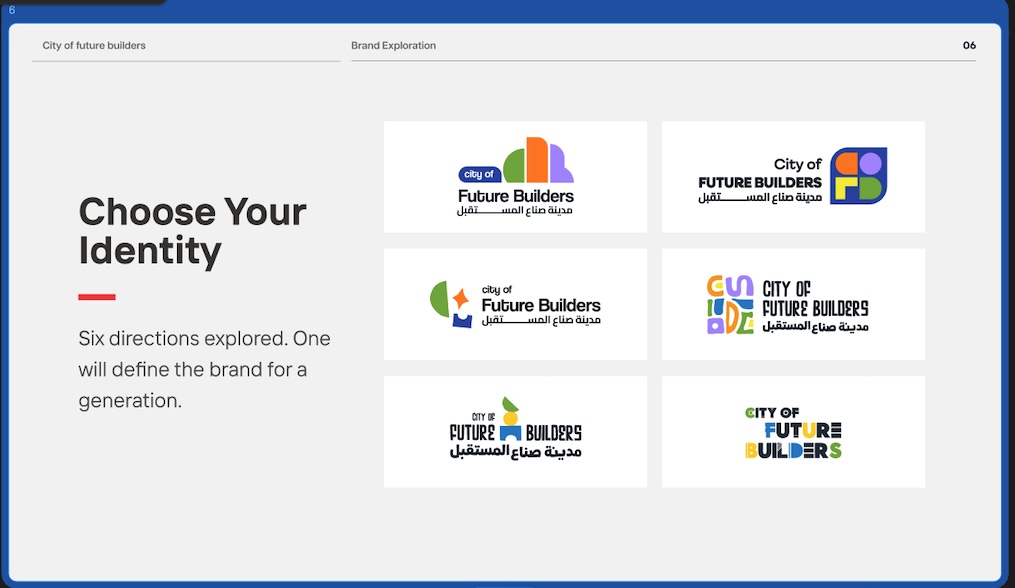
Final Six — Structured Presentation
All six logo directions compiled into a Figma presentation deck. Dina from Studio DDS (space concept developer) collaborated in the presentation. Full client team reviewed all six options together. Figma deck shared as permanent reference.
13 April 2026
Logo Selected — Final Refinements Requested
Client selected a preferred logo with three refinement requests: new “E” letterform, UAE nature-inspired colour palette, and additional Arabic typeface options. Abby delivered revised brand palette and typography options via Figma.
15–21 April 2026
Colour Variations Shared — Awaiting Final Selection
Colour variations shared with client. Hiba followed up on 21 April. Client confirmed final decision expected same day. Next phase: website and social media work to commence upon final logo approval.
This document is not a design report. It is a record of how a brand came to life through strategic leadership, creative resilience, and genuine collaboration across roles. It is written for internal leadership and future client conversations as a demonstration of what real brand partnership looks like in practice.
01
Introduction
The client, the vision, and why identity mattered from day one
مدينة صناع المستقبل — City of Future Builders. On the surface, it reads like an educational initiative. In reality, it is something far more nuanced: an experiential destination for children in the UAE, built around the belief that young people learn best when they explore, create with their hands, and connect with culture and nature directly.
The founder, Amal Bin Khatim, came to AIIMS with a vision that was vivid in her mind but had never been articulated visually. There was no brand. No logo. No identity. Only a deeply held philosophy and a physical space being built to bring it to life.
The brief was simple on paper and complex in practice: create a brand identity worthy of that philosophy.
For any organisation entering the UAE market — particularly one working with children, families, and educators — brand identity is not a cosmetic exercise. It is the first and most lasting impression. It communicates trust before a word is spoken. It signals whether a space belongs to the community or sits apart from it.
This project was led jointly by two distinct but complementary capabilities. Hiba Nadeem owned strategy, client direction, and communication — holding the vision together across every round of feedback and every moment of uncertainty. Abby El-Adib led art direction, translating strategic intent into visual exploration and guiding the design team through each iteration. The outcome was not the result of one role. It was the result of both working in sync.
02
The Challenge
When the brief becomes the problem
Most brand projects begin with a brief. This one began with a feeling.
The client knew what the space should feel like. She knew the values it should embody. She had references and colours and words she used to describe it. What she could not yet do was translate those instincts into the language of visual identity. That translation was the core challenge, and it fell to AIIMS to bridge that gap.
The initial direction provided a starting point: bilingual Arabic and English identity, blue, green and yellow tones, serif or handwritten typography, cultural depth, a sense of youth and future-orientation. It was directional but not definitive.
Each disapproval was not a rejection of the work. It was the client discovering, through the act of seeing options, what she actually wanted.
Additional complexity came from the stakeholder group. Multiple family members and collaborators were CC’d on every communication. Dina from Studio DDS, a space concept developer working closely with the client, had her own informed perspective on what the brand should communicate. Any design direction had to hold up under the scrutiny of a diverse and invested group.
There was also a fundamental positioning problem that needed to be surfaced before the design work could land. The brand was being developed for what felt like an educational institution. The reality was something closer to a cultural museum, a creative play space, a hands-on discovery environment. Until that distinction was made explicit, every concept was being judged against the wrong benchmark. Surfacing that truth required both strategic listening and creative sensitivity.
03
Strategic and Creative Alignment
How strategy and art direction worked together to move the project forward
The most important decision made on this project was structural: strategy and creative direction were treated as two separate but equally critical functions, each with a clear owner and a shared responsibility to the outcome.
Hiba Nadeem owned the strategy layer. She managed the client relationship, captured and analysed every piece of feedback, translated emotional responses into precise creative briefs, and ensured the work stayed anchored to the positioning problem being solved. When the client said a concept felt “too corporate” or “warmer,” Hiba did not pass those words directly to the design team. She decoded them, extracted the underlying need, and converted them into actionable direction.
Abby El-Adib owned the art direction layer. She received that strategic direction and translated it into visual exploration, guiding the design team through each round with a clear creative brief. She made decisions about composition, colour balance, typographic approach, and brand application — ensuring the work produced by the team was coherent, consistent, and aligned with the brief she had been given.
The Division of Responsibility
Strategy feeds creative. Creative informs strategy.
The two roles did not operate in silos. Hiba’s debrief after each client conversation directly shaped Abby’s brief for the next round. Abby’s visual output generated new information about what was possible, which in turn informed how Hiba positioned options to the client. This feedback loop — between strategy and design — is what allowed the project to keep moving forward through multiple rounds of disapproval without losing momentum or direction.
Layer 1 · Hiba Nadeem
Strategic Direction and Client Communication
Every client touchpoint was managed with deliberate intention. Feedback sessions were structured to extract maximum insight. Communications were drafted to manage expectations while keeping the creative process moving. And when the brief needed to evolve — as it did significantly after the first round — Hiba led that repositioning with clarity and without disrupting the client’s confidence in the process.
Layer 2 · Abby El-Adib
Art Direction and Creative Leadership
Abby’s role was to hold the visual standard across every round. She briefed and directed the designers — Lukas Kaung, Michael Gahona, and Aung Pyae Sone Oo — ensuring each concept served the strategic brief rather than pursuing creativity for its own sake. When the work needed to expand beyond the original direction, it was Abby who pushed the creative range while keeping the team grounded in what the brand actually needed to communicate.
04
Design Exploration
Six directions, multiple designers, one art director, one strategic brief
The logo design process moved through six distinct concept directions across multiple formal rounds. Each direction was commissioned with a specific strategic intent, briefed by Hiba and executed under Abby’s art direction. Each taught the team something the brief alone could not have revealed.
Round 1 · Feb 2026
Establishing the Territory
The first round produced two foundational concept directions, both grounded in the brand questionnaire. Typography used: Neulis Sans, selected for clarity and contemporary character.
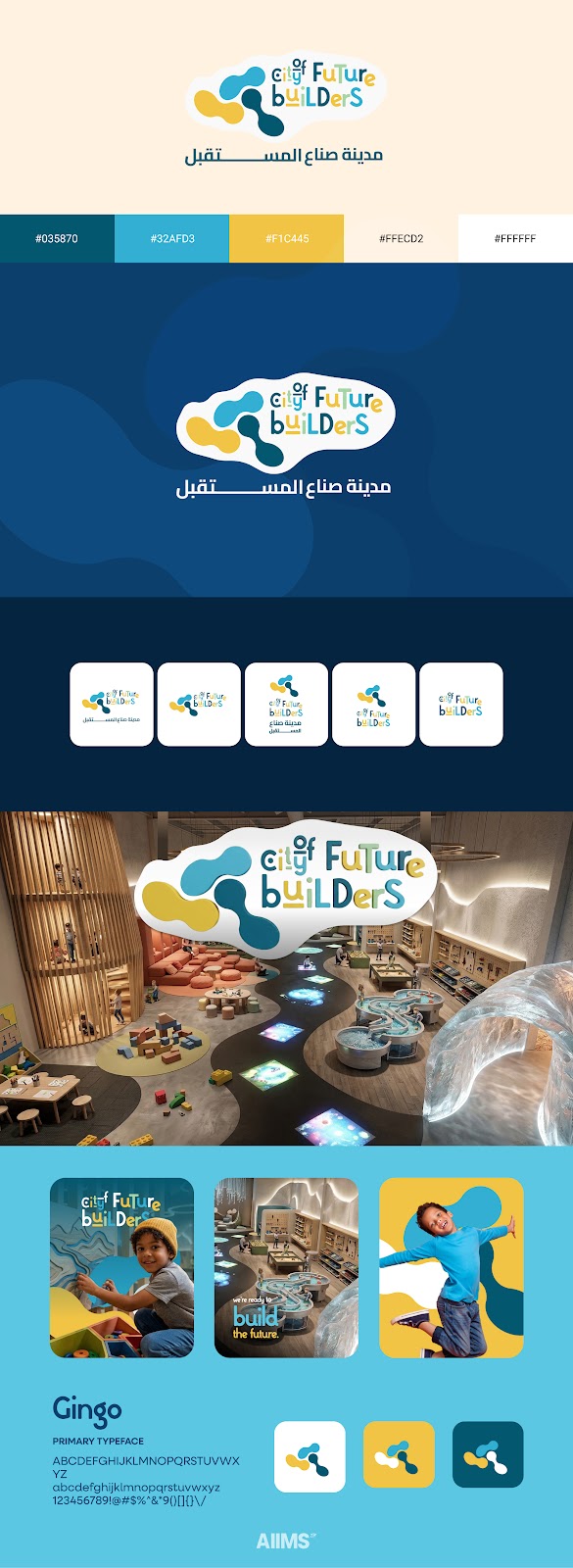
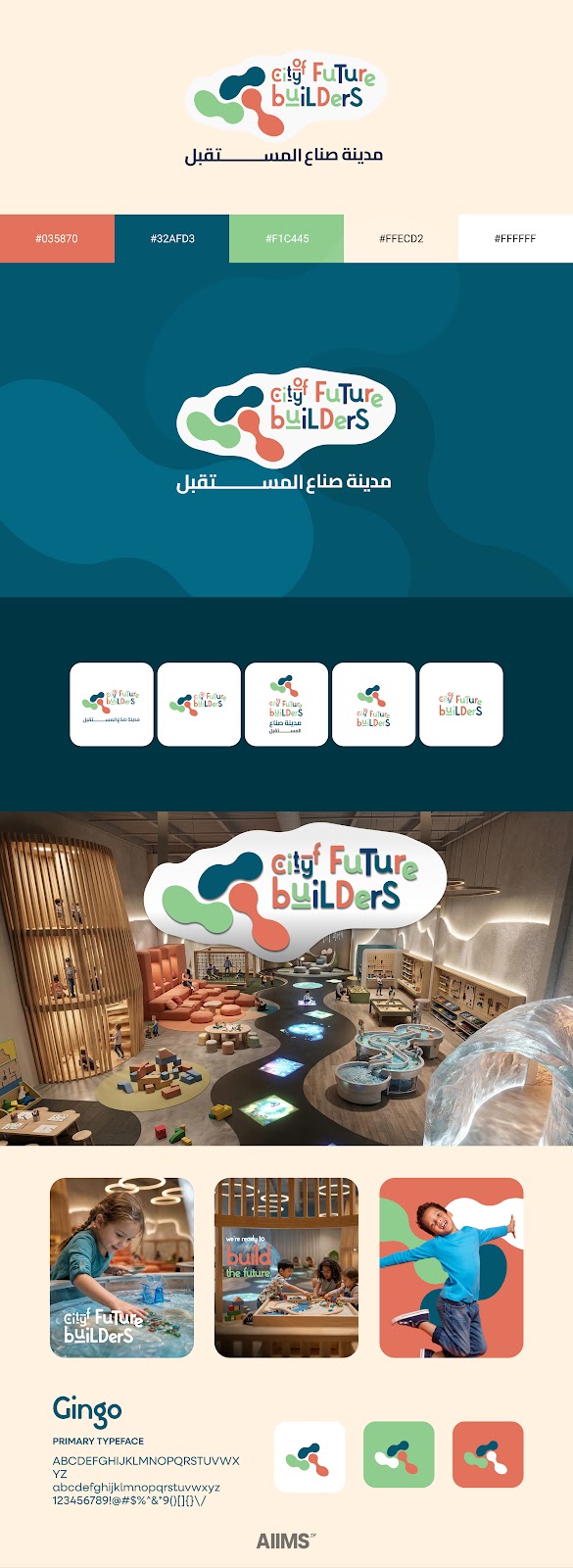
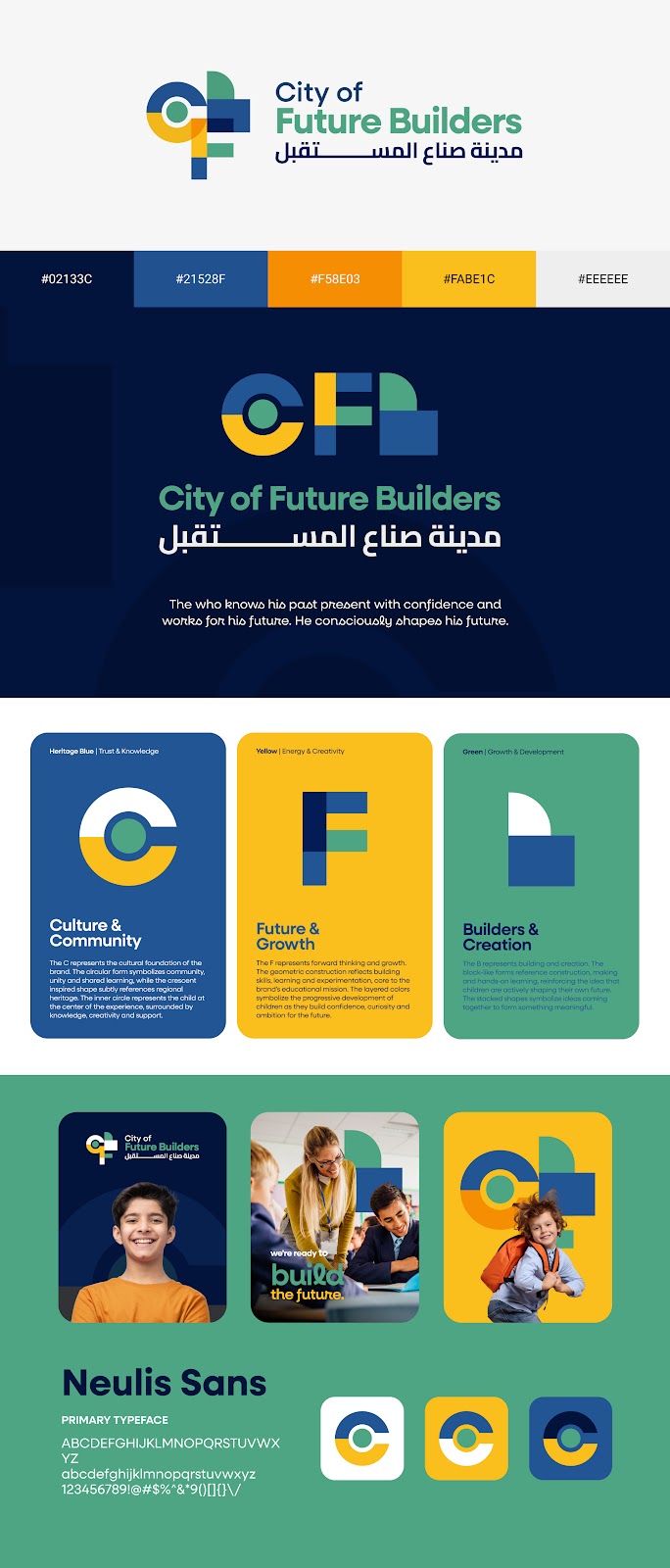
Option 1 — Community and Human Potential: Abstract human figures forming a unified symbol. Upward movement communicating growth, encouragement, and aspiration. Vibrant and energetic colour palette.
Option 2 — Culture, Future and Builders: Geometric forms subtly encoding the initials C, F, and B. Architectural and structured. Each element carried deliberate meaning: C = Culture and Community; F = Future and Growth; B = Builders and Creation.
Client Response — Round 1:
Round 2 · March 2026
Responding to Feedback — Version 2
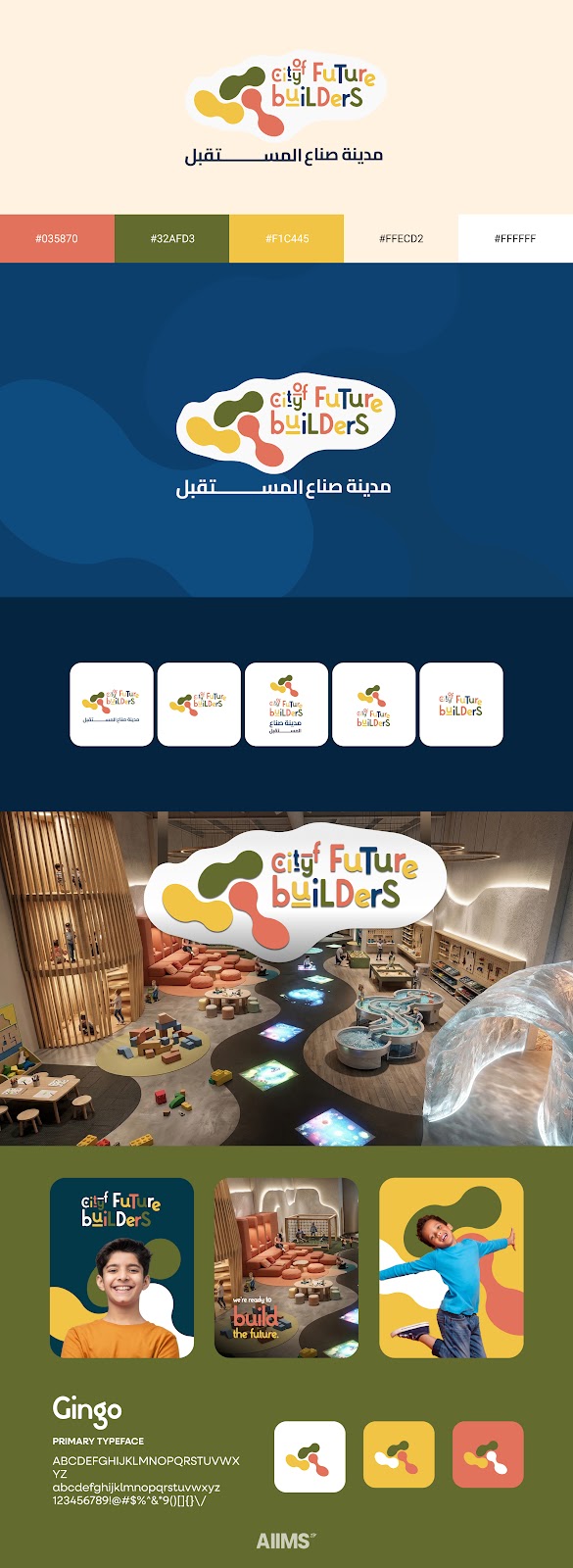
Abby El-Adib revised the Option 2 direction with adjusted colour palettes, revised applications across brand touchpoints, and updated mockup imagery. The core architectural concept was maintained while colour balance and visual harmony were refined.
Client Response: Positive about direction but not ready to commit. Requested bolder, more unexpected options that went beyond the original brief. Client’s instruction: “go crazy.”
Rounds 3, 4 & 5 · March–April 2026
Expanding the Creative Range
Three additional designers contributed to this phase under Abby’s art direction. The internal brief — written by Hiba from client feedback, translated into creative direction by Abby — was explicit: build something new from the same strategic foundation. Do not iterate on what has been done. Go further.
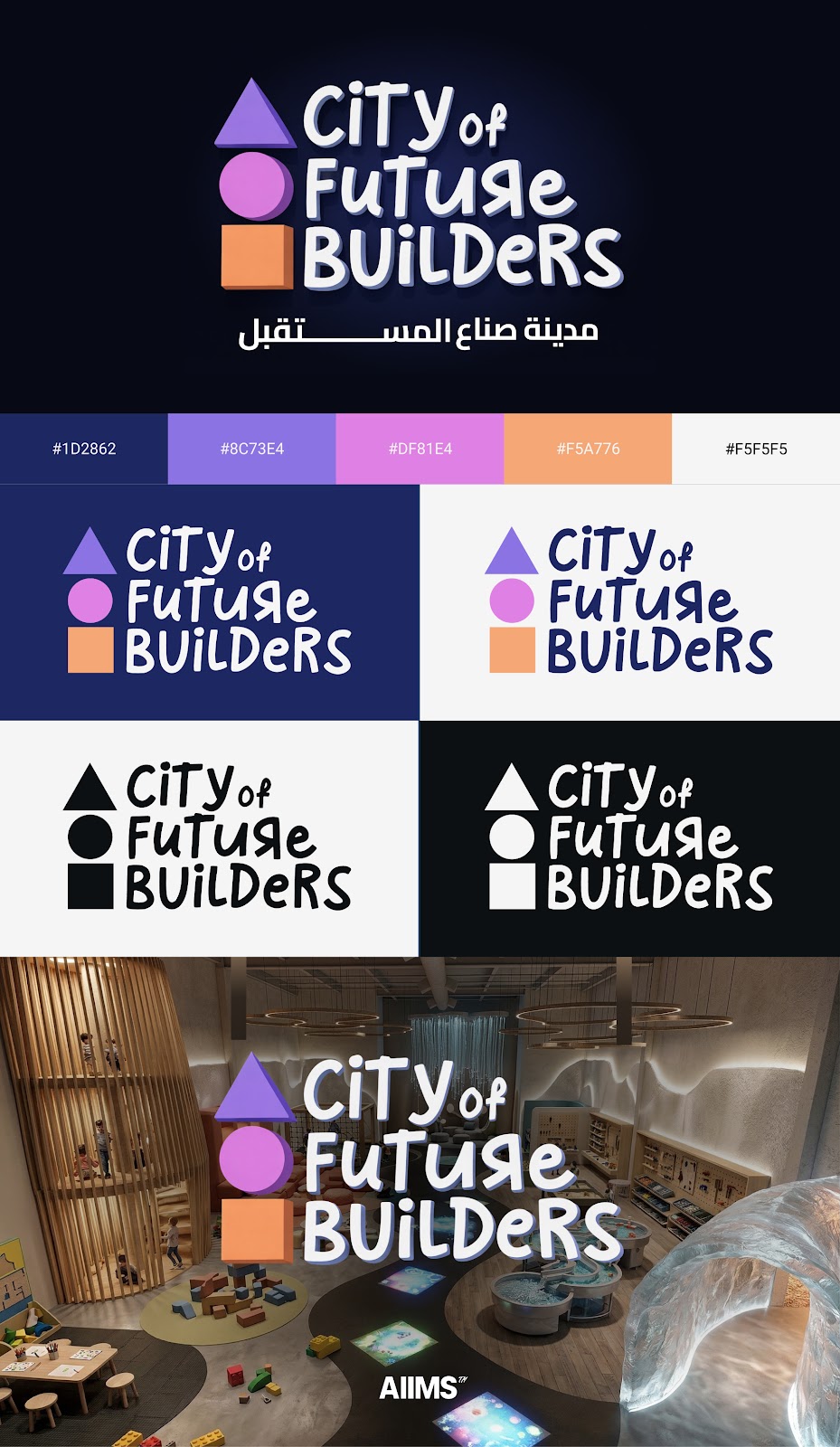
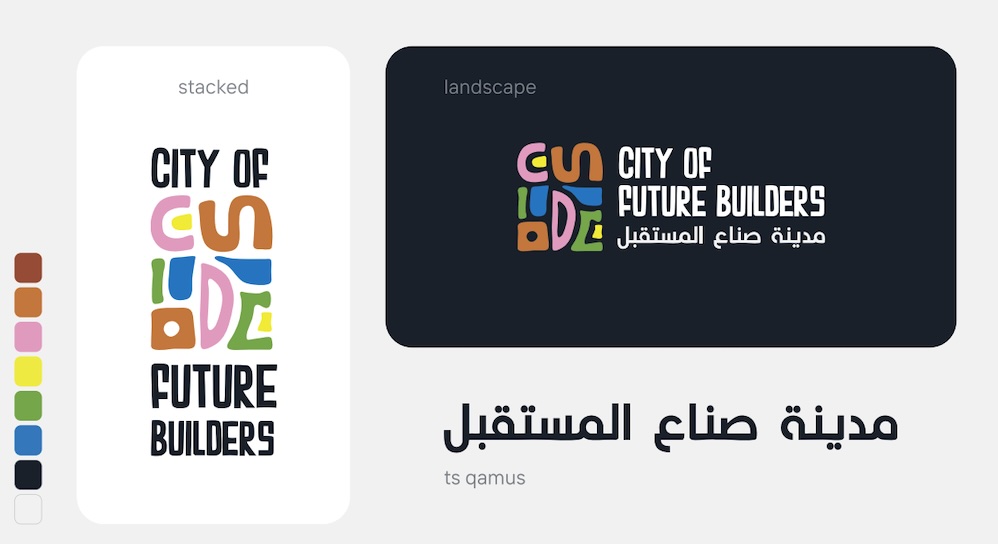
Options 3 and 4 were developed by Michael Gahona, exploring custom letterform treatments and symbol-led abstractions. Option 5 was developed by Aung Pyae Sone Oo, introducing a new visual direction grounded in the brand’s core pillars. Abby reviewed, refined, and approved each direction before it reached the client.
05
Iteration and the Feedback Loop
How each round of disapproval made the next round stronger
Iteration on this project was not a sign of failure. It was the method.
Each time the client declined a direction, Hiba ran a structured debrief. What specifically did not resonate? Was the issue the concept, the colour, the typography, or the application? Was the feedback about the logo in isolation or about what it communicated about the brand? These questions produced answers that were far more useful than the initial brief had been.
Those answers were then passed to Abby, who translated them into revised creative briefs for the design team. Abby’s role at this stage was not simply to pass on the notes. It was to interpret them visually — to understand what a client’s emotional response to a logo meant in terms of design decisions, and to brief the next round accordingly.
The feedback loop between strategy and design is where this project found its direction. Neither role could have done it without the other.
Over time, this loop produced a progressively clearer picture of the brand. The client’s language became more precise. The team’s responses became more targeted. What started as broad exploration narrowed, through iteration, into something specific, intentional, and genuinely resonant.
This is not a comfortable process. It requires both the strategic lead and the creative lead to remain confident in the process even when the output has not yet landed. Hiba held that confidence on the client-facing side. Abby held it on the creative side. Together they kept the project moving through every round of rejection.
06
The Turning Point
When strategy and design found the same direction at the same time
The turning point came from a conversation, not a design.
During the review call following the first round of concepts, the client clarified something that reframed the entire project. City of Future Builders was not a school. It was not an educational institution in any conventional sense. It was a play museum. An experiential space. A place where children would come to explore culture, engage with nature, and create with their hands in an environment that felt nothing like a classroom.
Every concept that had been developed up to that point had been benchmarked — consciously or not — against the visual language of education. That is not the visual language of wonder.
Hiba captured this insight and restructured the brief. Abby received it and restructured the creative direction. The moment both the strategic layer and the creative layer were operating from the same repositioned understanding of the brand, the work changed fundamentally.
The designers were no longer being briefed to create an educational logo. They were being briefed to create an identity for a place of wonder. That distinction produced different concepts, different colour instincts, different typographic choices. It changed what the team was trying to make.
The Repositioning That Changed Everything
Not a school. A play museum.
City of Future Builders is a place where children explore culture, engage with nature, and create with their hands. The brand identity needed to communicate wonder, discovery, and experiential learning. Once Hiba defined that strategically and Abby translated it creatively, the design process stopped cycling and started converging.
07
Final Outcome
Where strategy and design converged into a brand
The final direction selected by the client emerged from the sixth round of concepts. It was chosen not because it was the most polished option, but because it was the most honest expression of what City of Future Builders is — and because the team had done the work, across multiple rounds, to understand exactly what that meant.
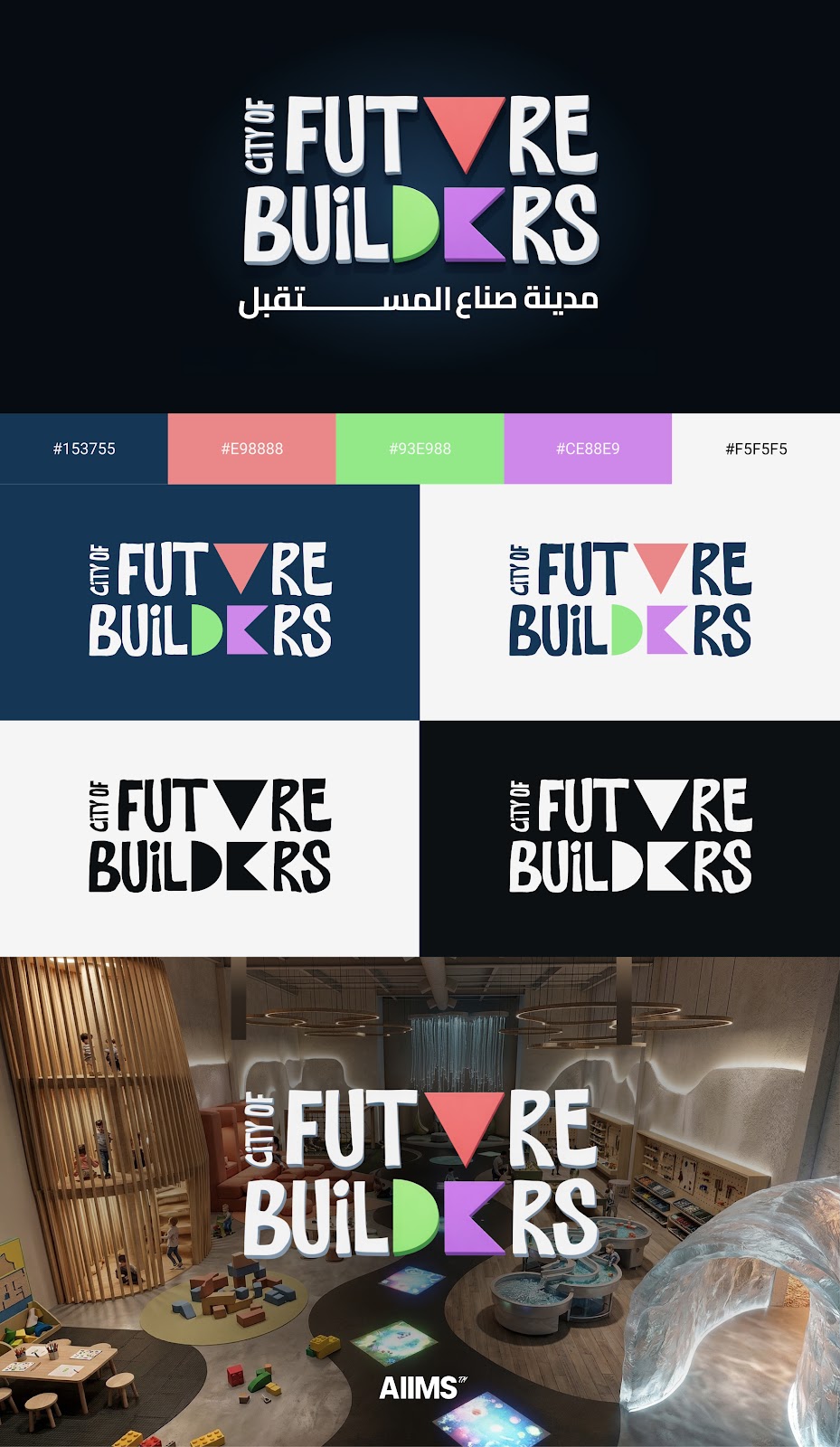
The identity carries the structural intelligence of the CFB concept developed in the early rounds, now expressed through a more distinctive typographic treatment and a colour palette drawn deliberately from the natural landscape of the UAE: warm, earthy, grounded, alive. The Arabic wordmark was given equal visual weight to the English, reflecting the bilingual, culturally rooted nature of the initiative. These were not styling decisions. They were the result of accumulated strategic and creative thinking across months of iteration.
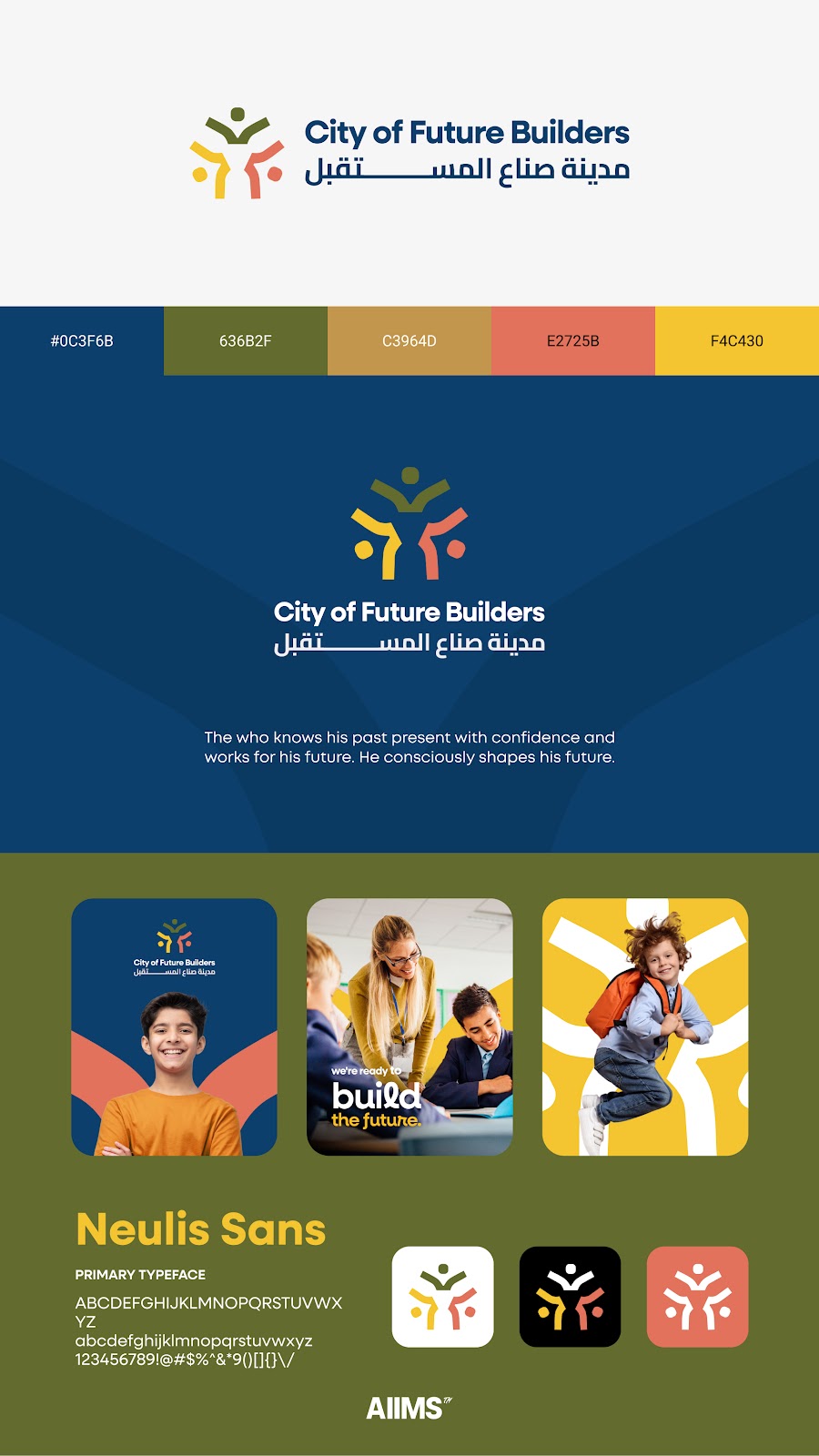
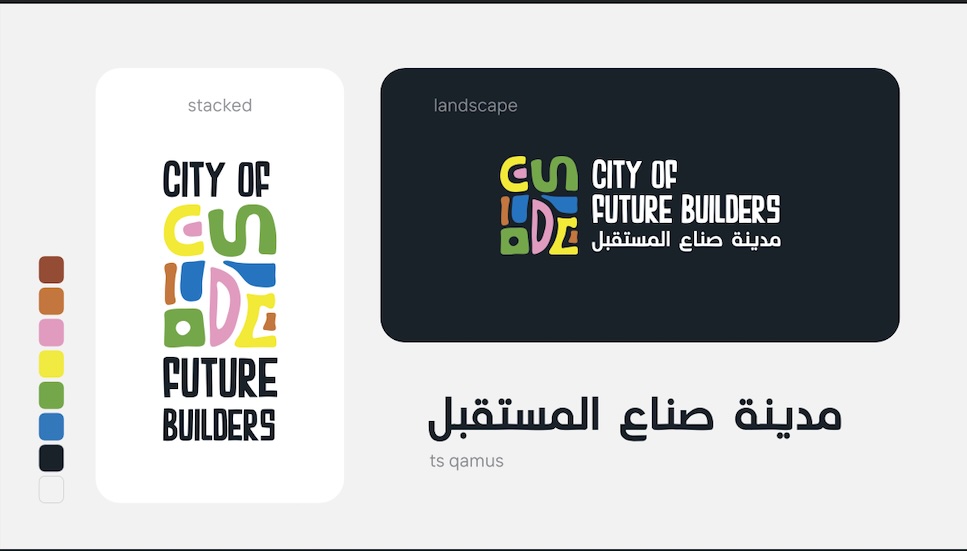
The final refinements — a revised treatment of the letter E, new Arabic font options, and a colour calibration based on UAE-nature references provided by the client — were executed by the design team under Abby’s direction, with precision and speed. Hiba managed the client communication through each micro-decision, keeping the process moving without losing the relationship.
The result is a brand identity that does not look like a school. It does not look like a government programme. It looks like a destination. It feels like an invitation. It communicates that this is a place where children are taken seriously as creative thinkers, that culture is celebrated rather than merely taught, and that the future is something being actively built by the people inside the space. That outcome belongs equally to the strategy that shaped it and the creative direction that gave it form.
08
Key Learnings
What this project teaches every brand team
01
Cross-functional collaboration is the competitive advantage.
The outcome of this project was not the result of one person’s talent or one role’s effort. It was the result of strategy and creative direction working as a single, coordinated system. When those two functions are misaligned, brand projects stall. When they are in sync, they compound each other’s effectiveness with every round.
02
Disapproval is information, not failure.
Every rejection in this process added precision to the brief. The team that treats client disapproval as failure produces work that manages expectations. The team that treats it as data produces work that genuinely resonates. This project went through six rounds because the team chose to learn from each one rather than defend what had already been done.
03
The brief is rarely complete at the start.
Clients often cannot articulate what they want until they see what they do not want. The role of a strategic partner is to create the conditions for that discovery. The role of an art director is to produce options clear enough to provoke genuine, useful reactions. Both are required.
04
Translating emotion into instruction is a skill.
Phrases like “more special,” “warmer,” “too corporate,” and “go crazy” are emotional signals, not design instructions. The gap between those words and a production-ready creative brief is where strategy lives. Closing that gap — consistently, across multiple rounds — is what kept this project moving forward when it could easily have stalled.
05
Bringing the client’s world into the room changes the work.
Involving Dina from Studio DDS — the person developing the physical concept of the space — was a strategic decision that paid off creatively. The brand identity stopped being designed in isolation from its context. It became grounded in the actual environment it would live in. That groundedness is visible in the final outcome.
06
Process is the product.
The client did not just receive a logo. She received a brand built through a process she was part of, that she shaped, and that she can therefore believe in completely. That ownership is worth more than any single design decision made along the way. It is also what makes the brand durable.
09
Conclusion
Partnership beyond the pixel
AIIMS is not a design agency that also does strategy. It is not a strategy agency that also does design.
It is both, working as one. The City of Future Builders engagement is a clear demonstration of what that means in practice: a strategic lead who understood the client’s vision and managed the complexity of getting there, and a creative lead who translated that vision into a visual identity the client could believe in. Neither role was secondary. Both were essential.
This is the model. Strategy defines the problem. Art direction shapes the solution. The client relationship holds it together. When all three are functioning — as they did here — the outcome is not just a logo. It is a brand that reflects genuine understanding of who the client is and what they are building.
The path from brief to brand is rarely straight. On this project it took six rounds, a fundamental repositioning, and months of disciplined iteration. What made it possible was not talent alone. It was structure, collaboration, and the willingness to keep going when the direction was still unclear.
That is what AIIMS brings to every brand engagement. And that is what this project proves.
——
The Team
People who built this brand
HN
Hiba Nadeem
Account Lead, Client Experience Manager
ZA
Zaid Awad
Account Manager
AE
Abby El-Adib
Designer — Rounds 2, 3 & Brand
LK
Lukas Kaung
Designer — Round 1
MG
Michael Gahona
Designer — Options 3 & 4
AP
Aung Pyae Sone Oo
Designer — Option 5
KA
Kynan Albassit
Design QA / Task Owner
FM
Fahd Mercy
Task Creation / Project Setup
JS
Janty S Mohammed Al Ayoubbi
Director of Strategy
AIIMS Group
Case Study
FLOWSAFE
Case Study · Plumbing · Melbourne, VIC
Flowsafe
Plumbing
A Blueprint for Market Dominance
Scroll
Under $60Qualified Lead Target
Under $6Average Cost Per Click
13+Landing Pages
14+Campaigns Active
8,000+Enquiries to Date
$50K+Weekly Revenue Target
The Challenge
From $800 a Day.
From $800 a Day.
Zero to Show for It.
The first call from Theo, owner of Flowsafe Plumbing, came in on 28 August 2024. He was running his own Google Ads campaign on an $800 daily budget and was lucky to get one or two calls a day. The spend was there. The strategy, structure and conversion infrastructure were not.
Flowsafe Plumbing Pty Ltd is a Melbourne-based, Australian-owned plumbing business offering 24/7 emergency and general plumbing services across Melbourne Metro and the South Eastern suburbs. Services span blocked drains, burst pipes, leak detection, gas fittings, hot water systems and water filtration. The operational foundation was solid. The digital presence was not reflecting it.
When the business came on board, the existing website was basic and not built to convert. There was no meaningful SEO footprint, no structured landing page network, limited lead tracking, no professional photography and no clear digital growth architecture.
How We Overcame It
- Launched local area landing pages immediately, giving campaigns a strong destination while the full website was being developed.
- Set up WildJar phone tracking at onboarding with 12 tracking IDs, closing the attribution gap from day one.
- Activated and optimised the Flowsafe Google Business Profile by October 2024.
- Organised a professional two-day photoshoot in November 2024 to create a complete brand asset library.
- Delivered the full website project across Q4 2024 and Q1 2025, supported by weekly meetings and structured approvals.
- Within three months, Flowsafe generated $38K in revenue in a single week from $9.6K in ad spend. Multiple weeks in 2025 exceeded $70K.
What We Built
A Full-Stack
A Full-Stack
Digital Engine
SEM Management
Google Ads strategy and delivery across 14+ active campaigns, supported by ongoing optimisation to improve lead efficiency and volume.
Multiple Landing Pages
Strategy, design and development of 13+ landing pages targeting specific services, suburbs and search intent across Melbourne.
Custom Website Design & Development
A complete branded website for flowsafepl.com.au, designed to convert with clear service architecture and strong enquiry paths.
Photo & Video Production
Two full days on site followed by an extensive editing and production phase, creating assets for the website, advertising and ongoing content.
Search Engine Optimisation
SEO targeting Melbourne-wide plumbing searches, with a focused push into Bayside and surrounding suburbs.
Google Business Profile Management
Ongoing profile optimisation, regular publishing and local ranking activity to strengthen local-pack visibility.
Print Design
Magnets, flyers, EDMs, capability material and sales collateral supporting lead conversion beyond the digital channel.
Google Ads Performance
Numbers That
Numbers That
Speak for Themselves
From an unstructured $800-a-day account with limited enquiry volume to a mature acquisition engine supported by search campaigns, landing pages, phone tracking and ongoing optimisation.
6.21M
Impressions
Total ad impressions served across campaigns
114.7K
Clicks
Total clicks to landing pages and website
1.85%
Click-Through Rate
Blended CTR across campaign activity
8,361
Conversions
Total tracked conversion actions
$5.83
Average CPC
Maintained below the $6 target threshold
$79.98
Blended Cost Per Conversion
All tracked conversion actions combined
$5M+
Attributed Revenue
Reported revenue connected to the wider digital acquisition program
Call Tracking — WildJar
Every Call. Tracked.
Every Call. Tracked.
Qualified. Booked.
7,539
Total Calls
6,461
Calls Answered
5,681
First-Time Callers
3,167
Bookings Made
Lead Quality
Qualified Leads4,524
Bookings Made3,167
First-Time Caller Rate75%
Booking Conversion Rate~70%
Call Performance
Answer Rate85.7%
Average Call Duration1 min 54 sec
Total Answered6,461
Tracking Numbers Active12 IDs
Of 7,539 tracked calls, 4,524 were classified as qualified leads. The 75% first-time caller rate indicates that campaign activity was consistently reaching new customers, while 3,167 bookings demonstrate the commercial value of the acquisition system.
Click to Conversion
The Landing Page
The Landing Page
Network
A network of purpose-built digital assets was created to capture high-intent searches and direct users into a focused conversion journey.
The Conversion Journey
1
Search Intent Captured
A customer searches for a plumber, service or suburb. The campaign directs that search to a page aligned with the exact intent.
2
Landing Page Converts
The page presents a clear headline, trust signals and direct call-to-action without unnecessary distractions.
3
Call Tracked Through WildJar
Each inbound call is attributed to the campaign and landing page that generated it.
4
Lead Qualified and Booked
The Flowsafe team answers the enquiry, qualifies the work and books the job.
5
Revenue Generated
Completed work and lead outcomes feed back into campaign optimisation and budget decisions.
Hyper-Local Targeting
Pages were aligned with specific suburbs, services and campaign themes.
Click-to-Call Prominence
Phone calls were prioritised across desktop and mobile experiences.
Trust Signals Built In
Clear service promises and practical customer reassurance reduced hesitation.
Mobile-First Design
Pages were structured for fast action on the device most customers use during urgent plumbing searches.
Distinct Campaign Brands
Names such as Mr Drainage and Same Day Heating gave campaigns stronger category relevance.
Continuous Optimisation
Messaging, layout and campaign alignment were refined using conversion and call data.
$60
Qualified Lead Target
Across the landing page network and active campaigns, qualified-lead performance was managed against an under-$60 target. The wider Google Ads account also recorded a blended cost per conversion of $79.98 across all tracked conversion types. Keeping those two measures separate makes the reporting clear and defensible.
Client Feedback
In Their Own Words
“The transformation has been incredible. From brand positioning to lead generation, every part of the strategy was executed with purpose. We’ve seen measurable growth across the board.”
Theo Vitos / Flowsafe Plumbing
Full Scope
Everything We Delivered
01
Google Ads Management
Strategy, campaign build and ongoing optimisation across 14+ campaigns.
02
13+ Landing Pages
Unique campaign brands, custom design and service or suburb targeting.
03
Custom Website & SEO
Complete website development and organic search targeting across Melbourne and Bayside.
04
Photo & Video Production
Two-day shoot and a full professional asset library for website and campaigns.
05
Google Business Profile & Print
Ongoing local profile management, content publishing and branded sales material.
“
Account Manager
Great results come from strong collaboration and strategic execution. This case study reflects the impact of aligning business goals with a scalable, data-driven marketing strategy.
Ravi Kavirajan
Client Experience Manager · AIIMS Group
Ready to Be the Next Success Story?
Let’s create a strategy that puts your business ahead of the competition.
The CSSDA crew are announced that the iecc.com.au website has been voted by the public to win Best UI Design, Best UX Design and Best Innovation!
The collaborative efforts between each department has proudly given AiiMS Group the lead with an award leading in User Interface, User Experience and Innovation.