
Shopify Agentic Commerce: The Future Of AI Shopping, Product Discovery & Ecommerce Growth.
AI shopping is no longer theory. Ecommerce stores can now generate traffic, customers and revenue from AI-powered discovery experiences including ChatGPT, AI Overviews, Microsoft Copilot and agentic shopping environments. AIIMS Group helps ecommerce brands prepare their Shopify stores, product data, SEO, GEO and content systems for the next era of product discovery.
Table of Contents
- The Future Of Ecommerce Is AI Discovery
- What Is Agentic Commerce?
- What Are Shopify Agentic Storefronts?
- Real ChatGPT Shopping Results
- How AI Product Discovery Works
- AI SEO For Ecommerce Stores
- GEO For Ecommerce
- AI Overviews & Product Visibility
- ChatGPT Shopping & Product Feeds
- Product Data Optimisation
- Content Strategy For AI Discovery
- How To Prepare Your Shopify Store
- Why AIIMS Group
- FAQs
The Future Of Ecommerce Is AI Discovery
Ecommerce growth has always followed discovery. In the 2000s, Google Shopping changed how consumers found products. In the 2010s, social commerce and marketplace algorithms reshaped buying behaviour. Now, a new shift is underway: AI-powered product discovery.
Consumers are increasingly using ChatGPT, Google AI Overviews, Microsoft Copilot and Perplexity to research, compare and buy products. Instead of scrolling through ten blue links, they ask an AI agent: “What’s the best wireless earphone under $200 in Australia?” and get a direct, curated answer with product recommendations, pricing and purchase links.
This is not a small behavioural shift. OpenAI reports that ChatGPT now processes over 1 billion queries per week, with shopping-related prompts growing faster than any other category. Google’s AI Overviews now appear in over 40% of commercial search queries in Australia. Brands that do not appear in these AI-generated answers are invisible to a growing segment of buyers.
For ecommerce brands, the question is no longer whether AI shopping matters. It is whether your store, your product data and your content are structured to appear when an AI agent goes shopping on behalf of your customer.
What Is Agentic Commerce?
Agentic commerce is a new model of online shopping where an AI agent acts on behalf of the consumer. Instead of the buyer manually searching, browsing and comparing products, the AI agent performs these steps autonomously, returning curated product recommendations, pricing and direct purchase options.
Think of it as the difference between searching for flights on Google (traditional ecommerce) and asking a travel agent to find and book the best option for you (agentic commerce). The “agent” is now an AI system like ChatGPT, Perplexity or Google Gemini.
How Agentic Commerce Differs From Traditional Ecommerce
Traditional Ecommerce
Consumer searches Google, visits multiple stores, compares products manually, adds to cart, checks out. The brand competes on SEO rankings, paid ads and on-site UX.
Agentic Commerce
Consumer asks an AI agent a question. The agent searches, compares and recommends products from multiple stores. The brand competes on product data quality, structured content and AI visibility.
Why This Matters Now
Shopify, the world’s largest independent ecommerce platform, has officially launched agentic storefronts. This means AI agents from ChatGPT, Perplexity and other platforms can now directly browse, query and transact with Shopify stores. The infrastructure for AI-powered shopping is live. Brands that are not prepared will lose market share to those that are.
What Are Shopify Agentic Storefronts?
In 2025, Shopify announced agentic storefronts, a new capability that allows AI agents to interact with Shopify stores programmatically. This is not a theoretical feature. It is live and operational.
An agentic storefront exposes your product catalogue, pricing, inventory and checkout to AI agents via a structured API. When a consumer asks ChatGPT to “find me an organic skincare set under $80 that ships to Melbourne,” the AI agent can now query Shopify stores directly, retrieve matching products, compare options and present a purchase-ready recommendation.
What Shopify Agentic Storefronts Enable
AI Product Search
AI agents can search your full product catalogue using natural language queries, not just keyword matching.
Real-Time Pricing & Availability
Agents pull live pricing, variant availability and shipping information directly from your Shopify store.
Direct Checkout
Some agentic flows allow the AI to generate a checkout link or complete a purchase on behalf of the consumer.
The Technical Foundation
Shopify’s agentic storefronts build on the Storefront API and Shopify’s product taxonomy. Stores that have clean, well-structured product data, accurate metafields and consistent taxonomy mapping will perform better in agentic queries. Stores with messy data, duplicate variants and incomplete descriptions will be deprioritised or excluded entirely.
Real ChatGPT Shopping Results
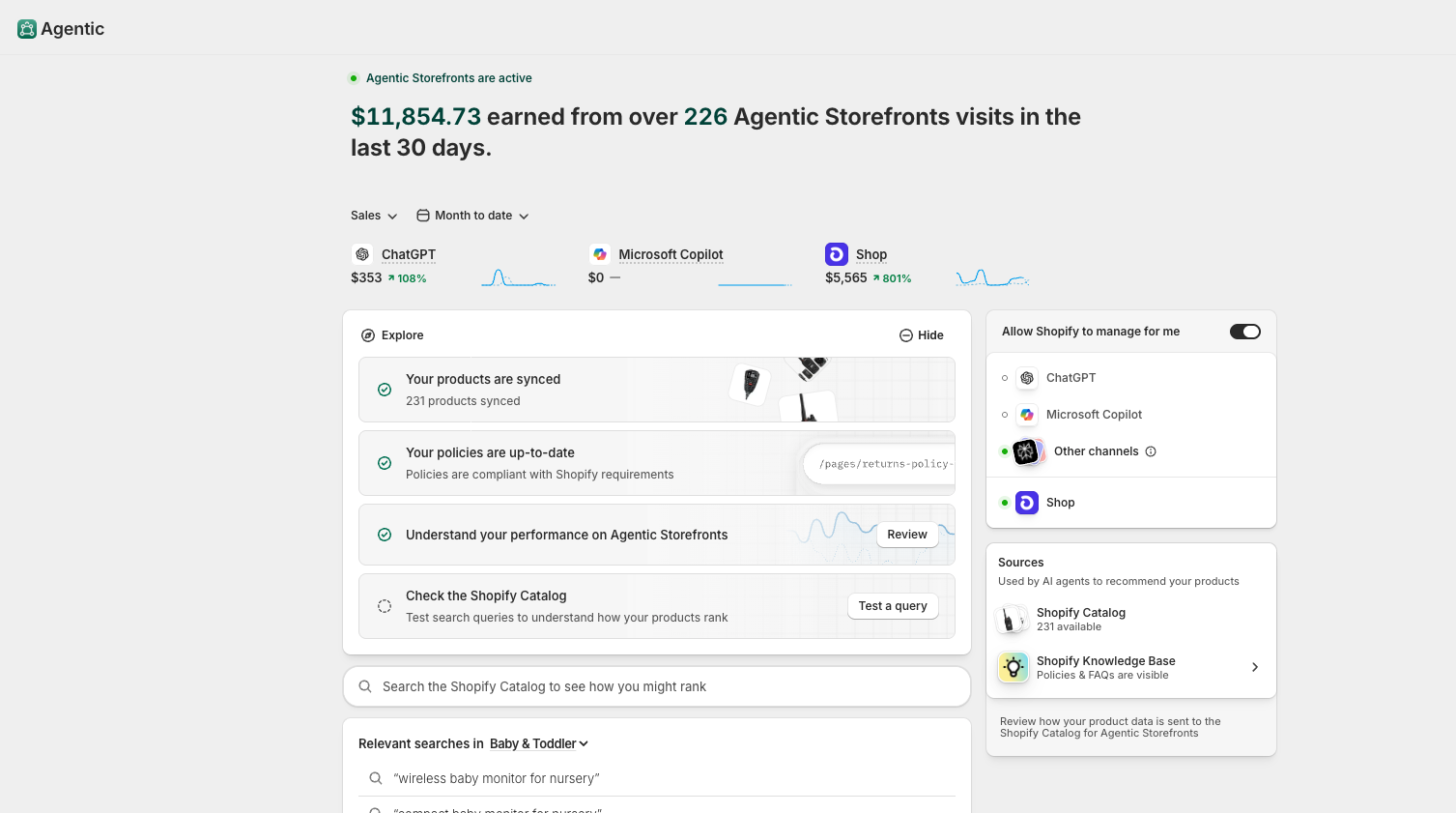
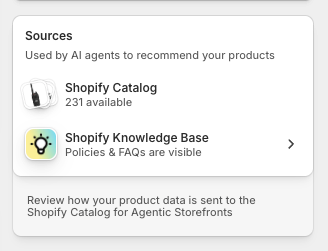
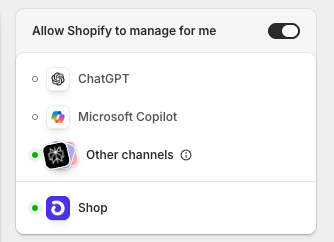
This is not a concept. AI shopping is already generating real traffic, customers and revenue for ecommerce brands. Below are actual screenshots showing how ChatGPT surfaces product recommendations and drives purchase behaviour.
How AI Product Discovery Works
AI product discovery is fundamentally different from traditional search. When a consumer types a query into Google, they receive a list of web pages ranked by relevance. When they ask an AI agent, the agent synthesises information from multiple sources, evaluates product attributes and returns a direct recommendation.
The AI Product Discovery Pipeline
Query Understanding
The AI parses the consumer’s intent, identifying product category, price range, attributes and location.
Source Retrieval
The agent searches product feeds, structured data, web content and APIs to find matching products.
Evaluation & Ranking
Products are scored on relevance, data completeness, reviews, pricing and availability.
Recommendation
The AI presents a curated shortlist with product details, comparisons and purchase links.
What This Means For Your Store
Your products are only discoverable if the AI can find them, understand them and trust them. This requires three things:
- Structured product data that AI agents can parse (schema markup, clean metafields, accurate taxonomy)
- Comprehensive content that answers the questions AI agents ask when evaluating products
- Authority signals that make the AI trust your brand over competitors (reviews, citations, backlinks, brand mentions)
AI SEO For Ecommerce Stores
AI SEO is the practice of optimising your ecommerce store to appear in AI-generated search results, not just traditional organic rankings. This includes ChatGPT responses, Google AI Overviews, Bing Copilot answers and Perplexity summaries.
How AI SEO Differs From Traditional SEO
Traditional SEO focuses on ranking web pages in a list of blue links. AI SEO focuses on getting your products and brand cited in AI-generated answers. The ranking factors are different:
Traditional SEO Signals
- Keyword density and placement
- Backlink quantity and quality
- Page speed and Core Web Vitals
- Domain authority
AI SEO Signals
- Structured data completeness (Product, FAQ, Review schema)
- Content comprehensiveness and answer density
- Brand mentions and citations across authoritative sources
- Product data accuracy and freshness
AI SEO Checklist For Shopify Stores
GEO For Ecommerce: Generative Engine Optimisation
GEO (Generative Engine Optimisation) is a discipline that specifically targets visibility in generative AI outputs. While AI SEO covers the broad practice of optimising for AI search, GEO focuses on the mechanics of how large language models select, cite and recommend content.
GEO Strategies For Ecommerce
Get Cited By AI
AI models cite brands that appear across multiple trusted sources. Build presence on review sites, industry publications, comparison platforms and expert roundups.
Structure For Extraction
Write product content in a question-answer format that AI models can directly extract. Use clear headings, concise paragraphs and definitive statements.
Become A Known Entity
AI models prioritise brands they recognise as entities. Build your Knowledge Panel, maintain consistent NAP data and create entity-rich content.
AI Overviews & Product Visibility
Google AI Overviews (formerly SGE) now appear at the top of search results for a significant percentage of commercial queries. For ecommerce brands, this means the traditional “position 1” organic ranking is no longer the most visible placement. The AI Overview is.
How Products Appear In AI Overviews
Google’s AI Overviews pull product information from three primary sources:
- Google Merchant Center feeds: Structured product data submitted via your Shopify Google channel
- Product schema markup: JSON-LD structured data on your product pages
- Web content: Comprehensive product descriptions, buying guides and comparison content
Stores that have all three sources optimised and consistent are significantly more likely to appear in AI Overview product carousels and recommendations.
ChatGPT Shopping & Product Feeds
OpenAI has launched native shopping capabilities within ChatGPT. Users can now ask ChatGPT to find, compare and recommend products, with results that include product images, pricing, reviews and direct purchase links.
How ChatGPT Finds Products
ChatGPT’s shopping feature pulls product information from:
- Shopify’s product catalogue via agentic storefront APIs
- Web crawling of product pages with structured data
- Product feeds submitted to shopping aggregators
- Brand content from authoritative web pages, reviews and comparisons
Optimising For ChatGPT Shopping
To maximise your products’ visibility in ChatGPT shopping results:
Product Data Optimisation
In the agentic commerce era, your product data is your most valuable asset. AI agents evaluate products based on data quality, completeness and consistency. Stores with rich, structured product data will be recommended more often than stores with thin or inconsistent data.
Critical Product Data Fields
Required Fields
- Product title (clear, descriptive, keyword-rich)
- Full description (400+ words, features, benefits, use cases)
- Price and sale price (accurate, real-time)
- Availability status (in stock, out of stock, preorder)
- Product images (multiple angles, lifestyle, white background)
- SKU and GTIN/barcode
Enhanced Fields
- Material and composition
- Dimensions and weight
- Care instructions
- Shipping information and delivery estimates
- Return policy details
- Customer reviews and ratings
Content Strategy For AI Discovery
Content is the bridge between your product data and AI visibility. AI agents do not just read your product pages. They read your entire site: blog posts, buying guides, comparison articles, FAQ pages and collection descriptions. The more comprehensive, authoritative and well-structured your content ecosystem, the more likely AI agents are to recommend your products.
Content Types That Drive AI Visibility
Buying Guides
“How to choose the right [product category]” content that mirrors the questions AI agents process when evaluating products.
Comparison Content
“[Product A] vs [Product B]” articles that give AI agents the comparative data they need to make recommendations.
Expert Roundups
“Best [product category] in Australia 2026” content that positions your products alongside competitors with clear differentiation.
How To Prepare Your Shopify Store
Preparing your Shopify store for agentic commerce requires action across four areas: technical infrastructure, product data, content and authority building.
Your AI Commerce Readiness Checklist
- Enable Shopify’s agentic storefront features
- Implement comprehensive Product schema (JSON-LD)
- Submit feeds to Google and Bing Merchant Centers
- Ensure clean URL structure and canonical tags
- Optimise Core Web Vitals and mobile performance
- Enrich all product descriptions to 400+ words
- Complete all metafields (material, size, weight, care)
- Add GTIN/barcode to every product
- Upload multiple product images per SKU
- Map products to Shopify’s standard taxonomy
- Publish buying guides for each product category
- Create comparison content for top-selling products
- Write FAQ content for common purchase questions
- Build collection page content with category expertise
- Internal link from blog content to product pages
- Build citations on review and comparison platforms
- Encourage and aggregate customer reviews
- Earn brand mentions in industry publications
- Maintain consistent NAP and entity data
- Build your Google Knowledge Panel
Why AIIMS Group
AIIMS Group is an Australian digital marketing and performance agency established in 2010. We work with ecommerce brands across Australia and the UAE to build growth systems that drive measurable revenue.
Our team has been at the forefront of AI-powered marketing since 2023, when we began integrating AI SEO, GEO and agentic commerce strategies into our client workflows. We are one of the first agencies in Australia to operationalise Shopify’s agentic storefront capabilities for clients.
What We Deliver
AI Commerce Audits
Full assessment of your Shopify store’s readiness for agentic commerce, including product data quality, schema coverage and content gaps.
Product Data Engineering
Systematic enrichment of your product catalogue: descriptions, metafields, taxonomy mapping and feed optimisation.
AI SEO & GEO Strategy
Ongoing optimisation to increase your brand’s visibility in ChatGPT, AI Overviews, Copilot and agentic shopping results.
Frequently Asked Questions
What is Shopify Agentic Commerce?
Shopify Agentic Commerce refers to Shopify’s new capability that allows AI agents (from platforms like ChatGPT, Perplexity and others) to browse, search and transact with Shopify stores programmatically. It turns your store into an API-accessible product catalogue that AI agents can query on behalf of consumers.
How does ChatGPT shopping work?
ChatGPT shopping allows users to ask product-related questions and receive curated product recommendations with images, pricing and purchase links. ChatGPT pulls product data from web crawling, product feeds, structured data and agentic storefront APIs.
What is AI SEO for ecommerce?
AI SEO is the practice of optimising your ecommerce store to appear in AI-generated search results, including ChatGPT responses, Google AI Overviews and Bing Copilot answers. It focuses on structured data, content comprehensiveness and brand authority rather than traditional keyword rankings alone.
What is GEO (Generative Engine Optimisation)?
GEO is a discipline focused on increasing visibility in generative AI outputs. It involves citation building, answer architecture, entity optimisation and content structuring to maximise the likelihood that AI models cite and recommend your brand.
Do I need Shopify Plus for agentic storefronts?
Currently, Shopify’s agentic storefront features are available across Shopify plans, though advanced API access and customisation may require Shopify Plus. Contact AIIMS Group for a specific assessment of your store’s requirements.
How long does it take to see results from AI commerce optimisation?
Most ecommerce brands begin seeing increased AI visibility within 8 to 12 weeks of implementing product data enrichment, schema markup and content strategy changes. Full revenue impact typically becomes measurable within 3 to 6 months.
Do product descriptions matter for AI discovery?
Yes. AI agents evaluate product descriptions to understand what a product is, who it is for and how it compares to alternatives. Thin or generic descriptions make it harder for AI to recommend your products confidently. Aim for 400+ words per product with specifications, use cases, benefits and comparisons.
Do collection pages matter for AI shopping?
Absolutely. Collection pages with rich, category-level content help AI agents understand your product range and expertise in a category. Well-structured collection pages with unique descriptions, FAQ content and internal links to products improve your store’s overall AI visibility.
Ready To Prepare Your Store For AI Commerce?
Book a strategy session with AIIMS Group. We will audit your Shopify store, assess your AI commerce readiness and build a roadmap to capture revenue from agentic shopping, ChatGPT product discovery and AI search.