AI did not just cite Uniden.
It sold Uniden.
How AIIMS Group transformed Uniden Australia from a conventional ecommerce brand into an AI-visible, AI-recommended and revenue-producing commerce destination.
TL;DR
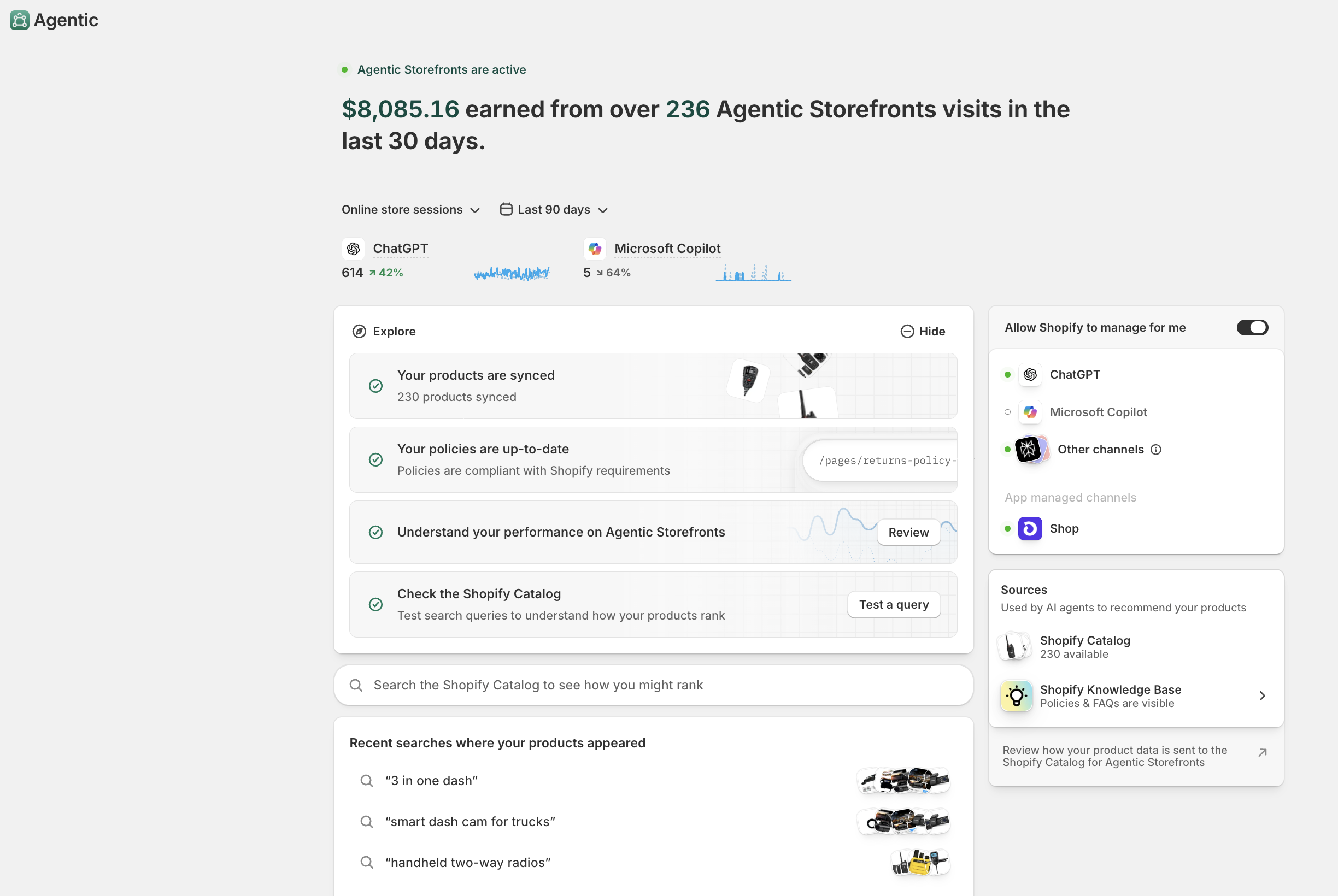
AIIMS built a connected AI visibility and ecommerce system for Uniden Australia. The work increased Uniden’s presence inside AI-generated answers, produced measurable referral traffic from ChatGPT, Gemini and Perplexity, and converted Agentic Storefront visits into more than $8,000 in tracked revenue within 30 days.
Being visible on Google was no longer enough.
The customer journey was changing. Product research was moving into conversational platforms, where people ask direct questions and expect a trusted recommendation rather than ten blue links.
For Uniden, the commercial issue was straightforward: if AI systems could not clearly understand the brand, products, expertise and category authority, competitors could become the recommended answer before a shopper ever reached Google or the Uniden website.
- Increase visibility across generative AI discovery platforms.
- Build category authority around UHF radios, dash cams, baby monitors and security products.
- Turn AI visibility into qualified website sessions.
- Connect AI discovery with a measurable ecommerce outcome.
Build for people, search engines and AI agents at the same time.
AIIMS treated AI discovery as an infrastructure problem, not a content gimmick. The solution connected technical SEO, entity clarity, structured product information, commercially useful content and ecommerce readiness.
Entity clarity
Strengthen the signals that explain who Uniden is, what it sells, where it operates and why it is authoritative.
Answer-led content
Create useful, category-specific answers that match the way people question ChatGPT, Gemini, Perplexity and other AI systems.
Commerce structure
Improve product, category and supporting information so machines can interpret offers, specifications, availability and relevance.
Measurement
Track citations, AI referral sessions, Agentic Storefront visits and revenue to prove the work commercially.
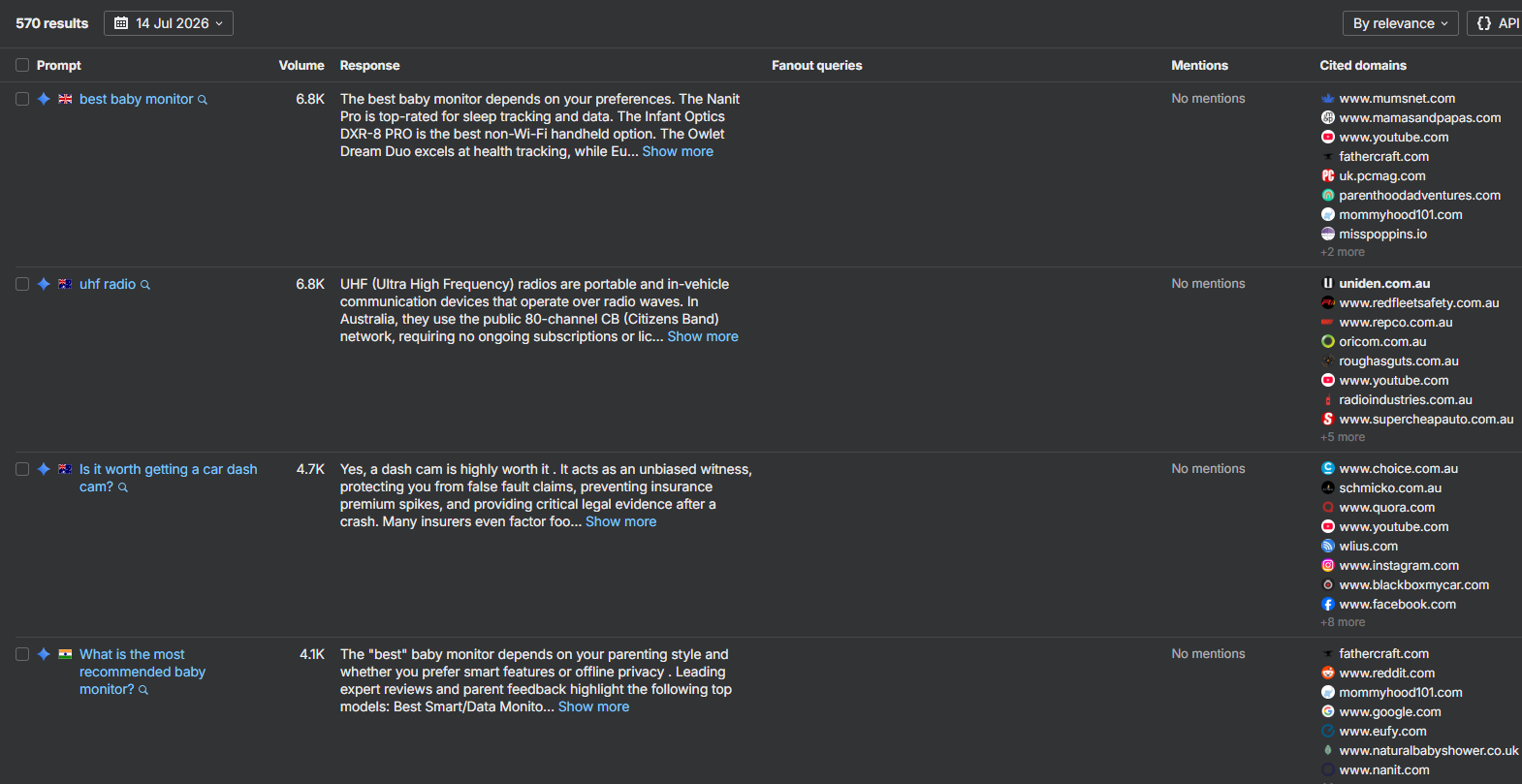
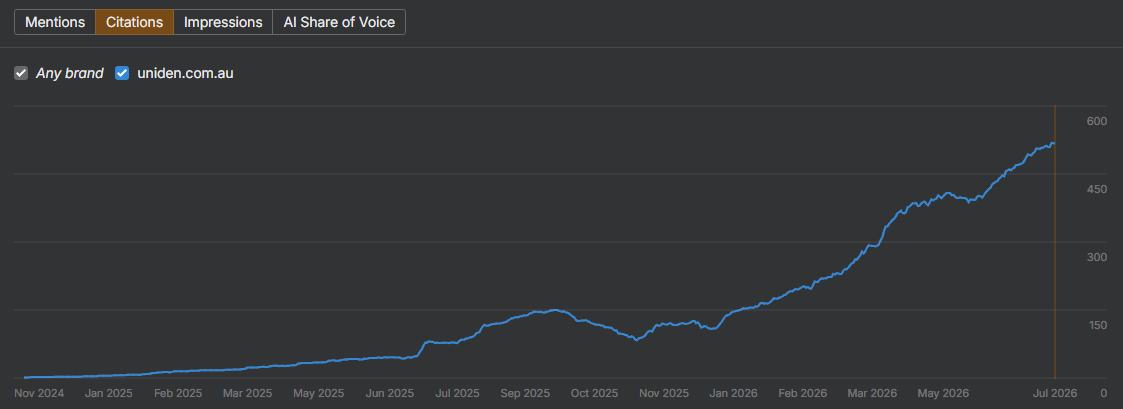
From near-zero visibility to 570 AI citations.
Uniden’s citation profile accelerated as its digital authority, content coverage and machine-readable product ecosystem improved. The growth was not confined to brand-name searches. AI systems began citing Uniden against high-value, category-level questions.
That distinction matters. Branded visibility confirms awareness. Non-branded citation visibility creates new demand by putting the brand in front of customers who have not yet decided what to buy.
AI is discussing Uniden in the categories that drive revenue.
UHF Radios
Uniden is cited for high-intent UHF radio questions where Australian buyers compare trusted options.
6.8K query volumeBaby Monitors
Visibility against “best baby monitor” style searches places Uniden into consideration before a retailer comparison begins.
6.8K query volumeDash Cams
AI cites Uniden while shoppers are assessing whether a dash cam is worthwhile and which features matter.
4.7K query volumeProduct Recommendations
Uniden appears in broader “most recommended” product questions, extending authority beyond direct brand searches.
4.1K query volume
The citation curve and traffic curve moved together.
AI citations are valuable only when they contribute to commercial discovery. Uniden’s traffic trend rose as the brand’s citation footprint expanded, supporting the relationship between stronger authority, broader answer coverage and increased site discovery.
The critical point is not that AI replaced search. It expanded the number of digital surfaces capable of introducing Uniden to a customer.
1,326 measured AI-referred sessions in 2026 YTD.
The referral data confirms that people are moving from AI-generated answers into Uniden’s owned ecommerce environment. ChatGPT accounted for the majority of the measured traffic, with additional sessions from Perplexity and Gemini.
Source: Google Analytics 4, 2026 year-to-date dataset supplied for this case study. Duplicate source rows were consolidated by platform.
The proof moved from visibility to revenue.
An Agentic Storefront is not simply another marketing partner or referral source. It represents a separate commerce surface designed for AI-assisted discovery and shopping journeys.
Traditional ecommerce expects a person to open a website, navigate menus, compare pages and make the purchase. Agentic commerce begins with customer intent. An AI system interprets the request, identifies relevant products and helps move the customer toward a transaction.
Shopify’s broader direction is to make merchant products available wherever AI-led shopping conversations occur while keeping product data, checkout and operational control connected to the merchant’s Shopify infrastructure.
Generated from more than 236 Agentic Storefront visits during the most recent 30-day reporting window.
AI visibility is now a revenue channel, not a theory.
This case study shows why brands need to stop treating GEO, AEO and agentic commerce as isolated experiments. The commercial advantage comes from connecting them into one system.
Authority precedes recommendation.
AI systems need clear, consistent and useful evidence before they repeatedly cite a brand.
Recommendations create measurable traffic.
GA4 confirms that customers are clicking from AI platforms into Uniden’s owned digital ecosystem.
Commerce readiness captures the value.
Agentic Storefront revenue demonstrates that AI-led discovery can progress into a tracked transaction.
Do not wait for AI to decide your competitor is the answer.
AIIMS Group builds the content, technical infrastructure and commerce systems that help brands become visible, trusted and commercially active across AI-led customer journeys.
Build Your AI Advantage